While Projecting a Friendly Face and an Extended Hand, the Biden Administration Has Continually Challenged the Initiatives of Honduras’ New Progressive Government and Ignored the Voice of the Honduran People

By  James Phillips, Covert Action Magazine, May 3, 2023

This article is rather longer than those usually included in the bi-monthly additions to The Violence of Development website, but we deem it to be not just an informative and valuable guide to the current situation of governance in Honduras, but also a helpful summary of the history behind this situation. We are grateful to James Phillips and to Covert Action Magazine for their permission to reproduce the article in our website.

James Phillips is a cultural and political anthropologist with 40 years as a student of Central America. He has authored numerous articles and book chapters, and his latest book (‘Extracting Honduras: Resource Exploitation, Displacement and Forced Migration’) was published by Lexington Books in 2022. He can be reached at: phillipsj@sou.edu

The original article in Covert Action Magazine can be found at: https://covertactionmagazine.com/2023/05/03/while-projecting-a-friendly-face-and-an-extended-hand-the-biden-administration-has-continually-challenged-the-initiatives-of-honduras-new-progressive-government-and-ignored-the-voice-of-the/

Key words: Xiomara Castro; Juan Orlando Hernández; coup d’état; Zones of Special Economic Development (ZEDEs); US intervention; corruption; violence; assassinations
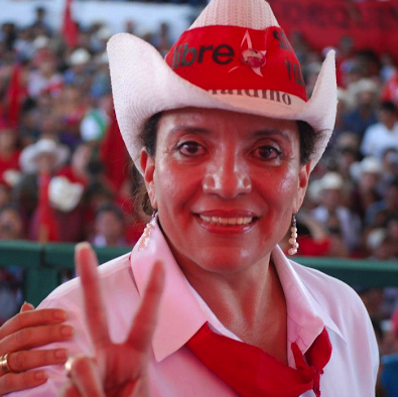
Honduras President Xiomara Castro [Source: resistediverso.blogspot.com]

The dangers of a coup remain, given past policies

In November 2021, Hondurans resoundingly elected a new government, headed by President Xiomara Castro, that pledged to end official corruption, reduce violence, and move away from reliance upon a destructive, extractive economy controlled by foreign corporations.

Castro’s government committed to moving the country toward an economy that allowed people to work for themselves, their families, and their communities instead of toiling for others while falling ever deeper into poverty and dependency. That election seemed a remarkable break, especially from the previous 12 years. But various dilemmas have plagued the new government’s attempts at change.
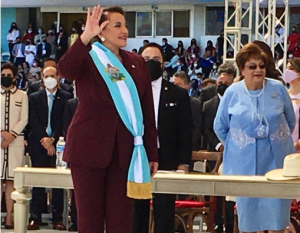
Xiomara Castro at her inauguration. [Source: Photo courtesy of Lucy Edwards]
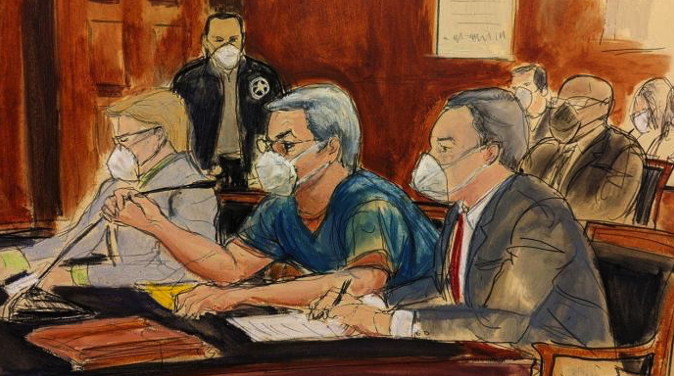
The former Honduran government of Juan Orlando Hernández, unwaveringly supported by the U.S., became a nationwide criminal enterprise that included gangs, drug traffickers and corrupt corporate interests—elements that continue today to foment daily violence and resistance within Honduras against any movement by the new government toward reform and renovation.

Sketch shows former Honduran President Juan Orlando Hernández in court after being charged with narco-corruption. [Source: cnn.com]

And the Biden administration has continually challenged the initiatives of the new Castro government and ignored the voice of the Honduran people.

The U.S. maintains control under the guise of partnership and assistance, peppered with criticisms and veiled threats. Given these pressures, what are the prospects for the future of Honduras, and for U.S. policy and practice?


Elections and the Popular Will

To understand the importance of the election of Xiomara Castro, it is useful to compare it to the three previous Honduran elections. The 2009 election was held in the wake of a coup d’état and it was “won” by those who had perpetrated the coup. The voting took place as the military and the police violently repressed massive popular protests that continued for months after the coup.

In the presidential elections of 2013 and 2017, Juan Orlando Hernández—one of the chief proponents of the 2009 coup—claimed victory, despite widespread claims that his National Party (Partido Nacional, PN) had won through fraud.

Hernández was not legally eligible to run for re-election in 2017 (the Honduran Constitution prohibits a president from running for a second term), but the Supreme Court that he had stacked with his own judges allowed it, ignoring the Constitution.

After each of these elections, protests erupted and were brutally repressed by security forces with liberal use of tear gas, beatings, arrests and killings. These post-coup years of National Party rule, when Hernández retained the presidency and systematically concentrated the powers of the state under his control, were marked by extreme violence (with a murder rate and a femicide rate among the highest in the world), pervasive official corruption, criminality with impunity, and deepening poverty, both for the nation and for a majority of Hondurans.

Meanwhile, the U.S. State Department accepted the validity of these elections and continued to certify that the Honduran government was making progress in protecting human rights and democracy—a conclusion that could only be arrived at by systematically ignoring the loud protesting voices of Honduran human rights leaders and popular organisations.
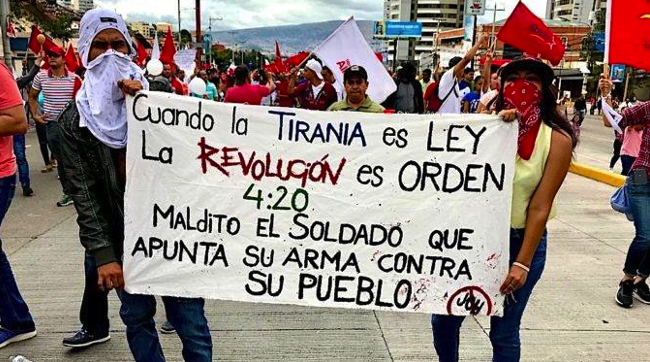
Demonstrators carry a banner reading, “When tyranny is law, revolution is order. Damn the soldier who points his weapon at his people.” Tegucigalpa, Honduras, December 3, 2017. [Source: upsidedownworld.org]

As the 2021 elections approached, Hernández’s hand-picked successor and the National Party hoped to retain power by offering “bonuses” to groups of people, especially poor households in rural areas, who would promise to vote for the PN. The PN also kept trying to revise voting laws and procedures so as to control local election committees, and to exercise coercion where it might be effective.

To oppose Hernández and the PN, three opposition political parties joined to support Xiomara Castro for president, with a platform that pledged to eliminate official corruption and impunity, protect women and human rights, and transform the country’s heavy dependence on resource extraction and foreign investment that had reduced many Hondurans to poverty.

In November 2021, the Honduran people overwhelmingly elected Castro. The parties supporting her gained a fragile majority in the Congress and control of several major cities. In the year since Castro’s inauguration, her government has faced increasing resistance from Hondurans who fear major reform; increasing criticism and impatience from those who voted for her and now want to see real change; and constant pressure from the United States to abandon plans for meaningful change. For the new Honduran government, this is a time of hope and danger.


Achievements of the New Government

Despite the headwinds, the Castro government has managed in its first year to take important steps toward fulfilling the promise of a better future for the country. The new Congress has repealed some of the previous legislation that had enabled impunity, corruption and the curtailment of labour rights.

The government is engaged in negotiations with the United Nations to establish an independent body that can investigate and begin to prosecute corruption. The government has also intervened in at least a few prominent cases to seek satisfactory solutions where communities were being forcibly evicted by corporations or large landowners. It has helped to dismiss some cases brought against human rights and environmental defenders by supporters of the previous government.

The President and the Congress have established entities and endorsed educational efforts to address the high rates of femicide in the country, although the results so far have been meager. The Congress passed a law establishing important assistance for the 300,000 Hondurans internally displaced by unlawful eviction and gang violence. These (and more) are a few important steps that hold promise.

The Castro government also declared a 30-day “state of exception” that suspended some basic rights in various neighbourhoods in Tegucigalpa and San Pedro Sula in order to crack down on the widespread criminal extortion of poor communities, small and medium-sized businesses, and the transport sector. The Congress then extended this for several more weeks.

Many Hondurans applauded this, since extortion has affected so much of Honduran daily life. But the use of the police and the military to carry out the crackdown is controversial, given the allegedly deep involvement of the security forces in criminal enterprises and their many alleged and documented human rights abuses.
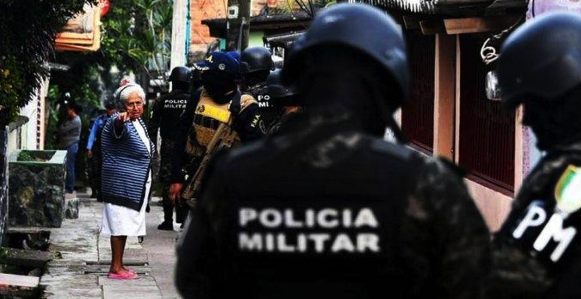
[Source: Confidencialhn.com]


The Dilemma of a Honduras “Open for Business”

At the core of the Castro programme is a transition from the foreign-dominated extractive political economy of the country—one that had in the past 12 years reduced Hondurans and their communities to dependents working to enrich others—to an economy that favoured the promotion of local initiative and greater national self-reliance.

The implications of such a transition are not only economic. They also signal a shift in identity and dignity for individuals, communities, and the nation itself. Clearly, such a transition would threaten the current situation in which Honduras is a colony, a source from which foreign corporate interests and a few wealthy Hondurans extract resources while leaving the Honduran people with a poverty level that currently stands at upwards of 73%, the second highest in the hemisphere. Corruption and state-sponsored or condoned violence are bitter fruits of this externally oriented colonial model. All of this is what the Xiomara Castro government has pledged to change, and what the Honduran people overwhelmingly voted to change.
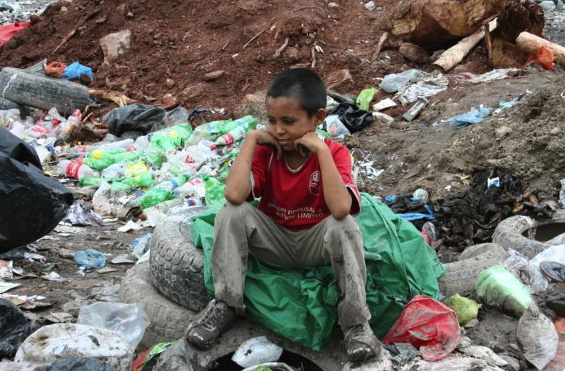
Poverty remains ubiquitous in Honduras. [Source: globalgiving.org]

Conflict is brewing in Honduras between the Castro government and the promoters and investors of the “special development and employment zones” (zonas especiales de desarrollo y empleo, ZEDEs). The ZEDEs are essentially sovereign enclaves for foreign investment and enterprise that are carved out of Honduran territory.

There are currently several ZEDEs in Honduras, all in the early or initial stages of development. For many Hondurans, including members of the business elite, the ZEDES represent a threat to Honduran communities and businesses and a violation of national sovereignty. Castro’s government and the new Honduran Congress recently repealed the law of the previous government that had authorized the creation of ZEDES.
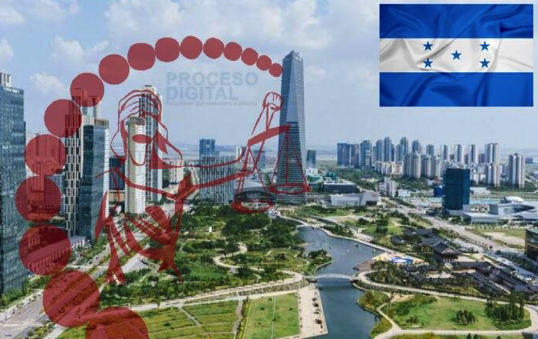
Blueprint for special economic zone. [Source: proceso.hn]

Developers of the Prospera ZEDE have charged breach of contract and have threatened a $10.75 billion lawsuit against the Honduran government unless the Congress reinstates legal permission for the ZEDEs. Additional pressure came from a letter by two U.S. Senators (a Democrat and a Republican) supporting the ZEDEs and criticizing the Castro government for obstructing free enterprise and “development” initiatives.

A Florida Congressman warned Honduras that it faces “serious sanctions” if it “illegally expropriates” U.S. investments in the Prospera ZEDE. U.S. Ambassador to Honduras Laura Dogu urged the government to keep the country open for business, by which she clearly meant business as usual, including the ZEDEs.
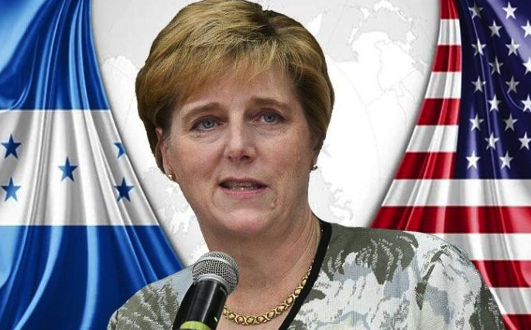
Laura Dogu [Source: processo.hn] Her remarks were taken as intrusive criticism, even a mildly veiled threat, and provoked a pointed response from Foreign Minister Eduardo Enrique Reina.

There are legal arguments to counter these threats, but the threats are significant, and they have generated further threats of legal action against the new government. Meanwhile, many Hondurans are demanding the repeal of the ZEDEs. The government feels pressure from outside and from its own people pulling in opposite directions.

From his prison cell in New York, Hernández himself issued an open letter to the people of Honduras. He and members of his close circle are in detention in the United States on charges of overseeing massive drug trafficking from Honduras to the U.S. during his presidency.

His open letter was a litany of his accomplishments for the Honduran people. The actual benefit of most of these “accomplishments” is questionable, but the letter painted a rosy picture of his presidency, ignoring the rise in violence, corruption and poverty under his rule. He also criticized the new government.

Why was Hernández allowed to write and publish this letter while he is in custody in the U.S.? It could only happen with the permission, perhaps even the blessing, of U.S. authorities. While the U.S. has offered friendly assistance and partnership to the Castro government, Hernández’s letter and its publication from a U.S. prison reinforces the idea that a largely unregulated extractive economy controlled by foreign interests must be maintained if Honduras is to prosper—a proposition clearly contradicted by the experience of the past 12 or more years.
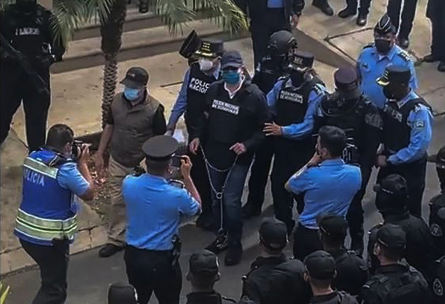
Arrest of Juan Orlando Hernández. [Source: getindianews.com]
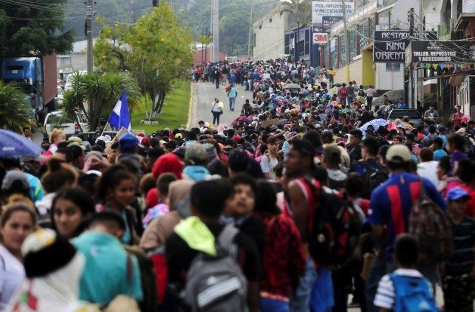
Significantly, Hernández’s letter to the Honduran people also seems to reinforce a basic policy assumption of the Biden administration’s initiatives for curbing emigration from Central America by supporting more foreign aid and investment in business as usual. It seems that the U.S. and other powerful interests continue to promote the same remedy that has sickened the patient.

Hondurans fleeing poverty and violence. [Source: jimbakkershow.com]

One might think that, if the United States were serious about curbing emigration from Honduras, it would embrace and support the efforts of the Castro government to make the transition to a political economy that actually enables Hondurans to work for themselves and their families instead of schooling them in dependence on foreign interests. Instead, the United States and the powerful foreign and Honduran interests that profit from the country’s colonial dependency are hard at work threatening, resisting and undermining almost every impulse and initiative for change from the new government or the Honduran people.


The Dilemma of Ongoing Violence

The Castro government has pledged to curb violence, but it faces the entrenched interests of powerful landowners, foreign corporations and politicians and activists of Hernández’s National Party, many who still control municipalities and regions of the country and have close ties to corrupt police and gangs. Police still engage in the eviction of poor communities at the behest of powerful and wealthy interests, and the criminalization of peasant and local community leaders who try to stop the theft of their land. It is proving difficult to combat a corrupt system that has had 12 years to grow. Violent incidents, threats, disappearances and assassinations continue.

Shortly after its inauguration in January 2022, the Castro government formed a Presidential Commission to investigate and respond to land conflict and violence against peasant communities and groups in the Aguán Valley. The conflicts arise in large part because of the often illegal and violent attempts of large landowners and corporations to take land from peasant communities and cooperatives.

The openness of the Castro government to assist peasant groups has generated new energy for these groups, but also a backlash from large landowners and corporations that takes the form of an increasing number of assassinations of peasant leaders and members of peasant organisations, according to the Honduran Centre for the Study of Democracy (CESPAD) and others.

Harassment and attacks against Indigenous and other rural communities over land and resource control continue in many parts of the country, including the north coast department of Atlantida, where powerful interests use hired gunmen (sicarios) to threaten members of local groups belonging to the National Confederation of Rural Workers (CNTC). There are too many incidents of this kind to detail here.
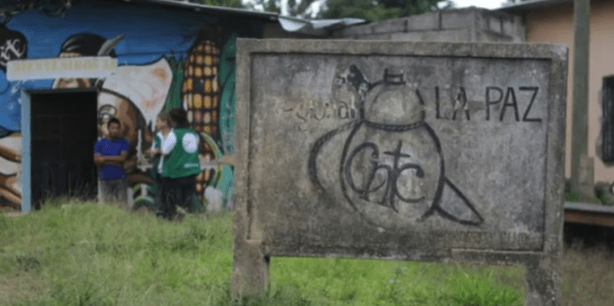
[Source: pbicanada.org]
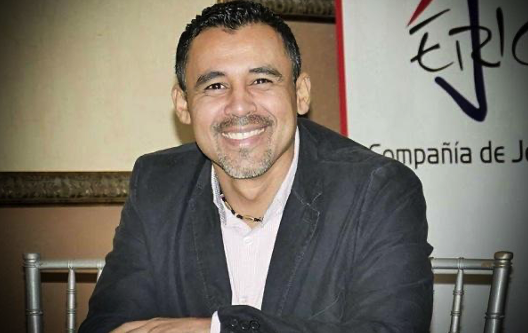
Some Hondurans see the roots of such violence in the interests behind the current extractive economy and the failure, so far, of the government to control unregulated extractive industries. Joaquín Mejía, a prominent Honduran human rights lawyer, said the new government was partially responsible for the murders inasmuch as it had failed to suspend or cancel the illegal mining concessions granted by the former regime.

Joaquín Mejía [Source: wp.radioprogresohn.net]

Over the past decade Honduras suffered one of the highest rates of femicide in the world. Despite the Castro government’s pledge to address and reduce the killing of women and other gendered violence, such violence has continued and even increased in the past months.

Some remaining members of the National Party in Congress continue to use obstruction and accusation to stop most attempts to repeal laws and policies of the previous government that encouraged corruption and impunity. There is a more sinister threat in this, as well.

In October 2022, a National Party member of the Congress issued a call for Hondurans to put on their white shirts, a reference to 2009 when supporters of the coup d’état wore white shirts. This was a not-so-veiled call for a coup against the Castro government.

The nationwide network or system of interrelated actors and interests that rely on violence and intimidation to accomplish their goals is based on relationships of collusion among corrupt police, criminal gangs, drug traffickers, PN activists, powerful landowners and those with vested interests in extractive industries, and their security guards, a network of corruption described in a 2017 report from the Carnegie Endowment for International Peace.

This interrelated network of interests and dependencies allows the powerful and prominent to use hired assassins to do the actual dirty work. Political and human rights assassinations can be made to seem like common crimes. This interrelated network of interests has not substantially changed since it formed under the former post-coup governments.

Its underpinning was widespread impunity for the perpetrators. The Hernández government and the National Party in Congress revised the Honduran Criminal Code to weaken the punishments for actual criminal behaviour while expanding the categories of popular protest and resistance that were defined as criminal behaviour, essentially turning the criminal justice system on its head—codifying a system of rewarding the perpetrators and blaming the victims. The Castro government has been working to repeal such laws and is faced with the enormous and dangerous task of trying to dismantle this system of violence, corruption and impunity.

The ongoing violence cannot be understood simply as a series of random or unconnected incidents. This violence serves several purposes. It targets and eliminates individuals who in any way contest, contradict or hinder the workings of the network of corruption. Individuals targeted for assassination can include local community leaders who try to protect the land and resources of the community from extractive projects. Or investigative journalists uncovering corruption. Or local leaders and activists of the government’s Libre Party. Or human rights defenders. Or women and leaders and members of the LGBTQ community. Violence can also take the form of threats, illegal evictions, repression and criminalization of communities that stand in the way of lucrative projects.
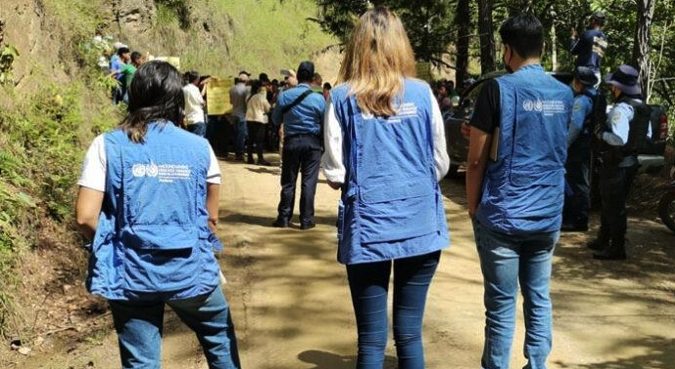
Investigation of death of community activist. [Source: processo.hn]

Eliminating these individuals and communities weakens the Castro government’s ability to fulfill its promised agenda, inasmuch as it eliminates some of Castro’s natural allies. The campaign of violence weakens the new government by creating a sense of chaos, and a government powerless to provide protection and stability. Creating chaos and fear is calculated to destroy people’s hopes in the Castro government.


The Dilemma of Dependence on the Security Forces

Some of these recent incidents reflect another major dilemma for the Castro government: its dependence on the country’s security forces. This poses concerns because of the role the security forces have played in recent Honduran history. The corrupt and dictatorial Hernández government relied on the military and the police to enforce its will and to enable its corruption.

The security forces were implicated in aiding the cover-up of assassinations, the unlawful eviction of communities at the behest of powerful corporations and landowners, and the brutal repression of peaceful popular protests. But the Castro government must do something to reduce gang and drug-trafficking violence and to address some other seemingly intractable problems such as environmental degradation and illegal land seizures. Using the security forces to address these problems is a temptation in a context where solutions and relief are demanded and are needed quickly.
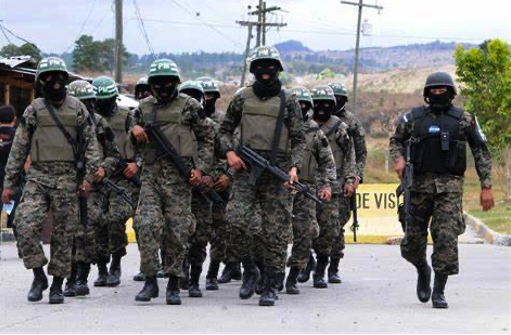
Honduran security forces have been implicated in their share of human rights crimes. This begs the question of how a progressive government should use them. [Source: ticotimes.net]

The Castro government pledged to disband the Military Police, reduce the power of the military, and clean up corruption in the National Police, but it has been hard for many Hondurans to see much progress toward these goals. The “state of exception” that the Castro government declared deploys the police and the military to enforce this.

But human rights leaders and others have expressed concern about the use of the security forces to combat extortion in certain cities since it provides the military and the police with yet another arena for increasing their hold over Honduran society and reflects the weakness of the government and civil society to deal with the problem. The Honduran military has in recent history staged coups against civilian governments it did not like.

After several decades of a rampant extractive economy—mining (including hundreds of broad mining concessions, some using open-pit mining with cyanide), as well as logging, plantation agriculture, tourism—Honduras faces serious environmental degradation. Mining and palm oil enterprises have also invaded legally protected ecological reserves such as the Carlos Escaleras National Park.
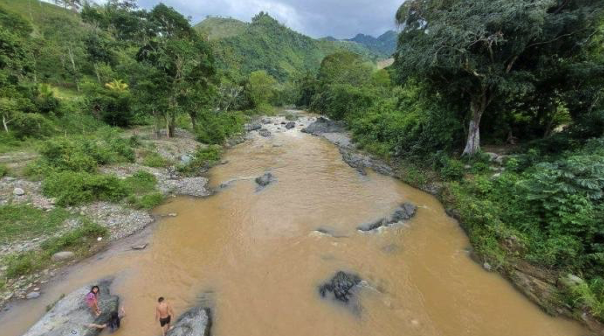
The San Pedro River, in the Carlos Escaleras National Park, was one of the many rivers under threat of devastation by open-pit mining. [Source: greenleft.org.au]

Local communities that have tried to defend their environment from extractive industries continue to suffer reprisals, as the now emblematic case of Guapinol illustrates. The Castro government plans to use the military to form “Green Brigades” to enforce environmental laws and reduce illegal land practices. The reliance on the military here is particularly concerning for many communities that have long endured the presence of the military as an occupying force in the service of the same powerful interests that are largely responsible for extractive destruction.

The close relationship of the Honduran military to the U.S. military has long been a source of concern about the very sensitive issue of sovereignty. The Castro government raised the hope that Honduras would be able to assert its independence in the face of strong pressures from the United States. This would be a major feat, given the history of U.S. influence over Honduran life. This concern over national sovereignty was exacerbated during the years of the Hernández government, and it continues unabated. Within this concern is the ongoing dilemma of how to reduce corruption and criminality in the security forces and change their entire ethos.
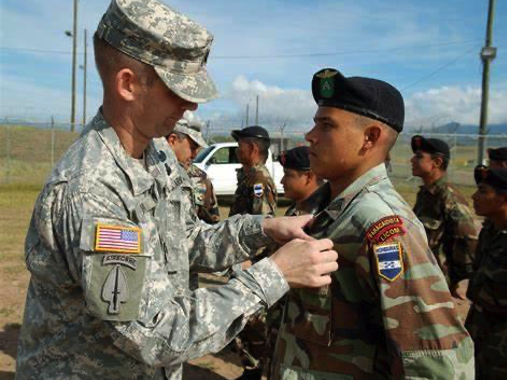
U.S. soldier pins lapel on Honduran trainee at the Soto Cano Air Base in Honduras. [Source: jtfb.southcom.mil]

Human rights leaders and many other Hondurans express serious concerns about the militarization of Honduran society. As if to heighten these concerns, the government’s proposed budget for 2023 includes an increase in funding for the security forces rather than the reduction that many expected. There is concern also that what is given to the security forces will be taken from important social services and other programs, just as it was under Hernández.

The critical response to Castro’s action can be seen clearly in this excerpt from a news report in CriterioHN, an important Honduran news outlet:

The promise to demilitarize security in Honduras remains a chimera, or at least this is evidenced by the actions of the government of President Xiomara Castro, who despite having promised to take the military off the streets, is doing the opposite by allocating them more resources compared to last year.


The Dilemma of Financing Change Without Selling the Country

All of this external and internal pressure is directed toward a Honduran government that is financially weak, dependent and vulnerable, and does not control the entire country. The past 12 years of post-coup governments, greatly increased the country’s debt (now estimated at close to 60% of the country’s GDP) while corrupt officials systematically pocketed huge amounts of state finances and starved basic social services.

The Castro government finds itself with a financial dilemma, needing money to pay the debt and to finance services such as public health and education that have been so neglected that they will require more money to restore and rebuild to adequate functioning. Sources of funding are problematic. With one of the poorest populations in the region, Honduras cannot rely heavily on taxes and fees from its own people.

Extractive industries bring in revenue, but many of these industries—mining, logging, export agriculture, tourism—also operate under contracts favourable to the investors and companies, contracts negotiated by the Hernández government, that enrich the extractors while returning little wealth to the country.

Mining actually provides only a small percentage of the country’s income, but it is protected by the powerful interests that benefit. Because Honduras has been so reliant on extractive industries, those who control them—both Honduran elite and foreign interests—wield an outsized influence in the country.

There are other sources of income for the Castro government. Foreign aid, loans and investment are available to the Honduran government. But since the government is known to be in need of money, it seems to be in no position to negotiate for favourable terms. The problem here is to distinguish what assists self-reliance and change from what reinforces dependency and “business as usual.”

The inherent danger with reliance on this area of finance is that government plans and programs are reshaped to suit the needs of the foreign sources of income, to put reform on hold in order to attract needed income. In addition, high levels of violence, corruption, and extortion in Honduras over the past decade have been a source of concern for some potential foreign investors. For those interests that want to cripple the Castro government, chaotic acts of violence serve the same purpose of discouraging investment.

Without the funds to service the debt and address basic social needs, there is a political price to be paid for deferring change indefinitely. It is the pressure from below, from the Honduran people who elected Castro and who need or expect her government to transform at least some of the worst conditions in basic services in the country. The urgency of this demand is becoming increasingly evident in the function of daily basic services such as public health and meeting needed raises to salaries for public workers such as nurses.
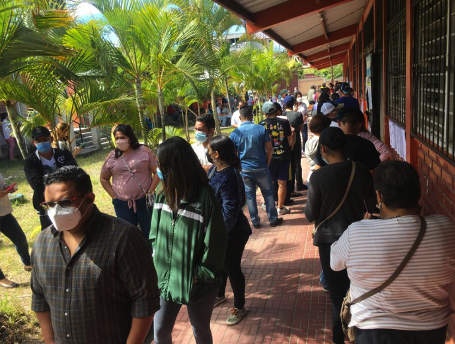
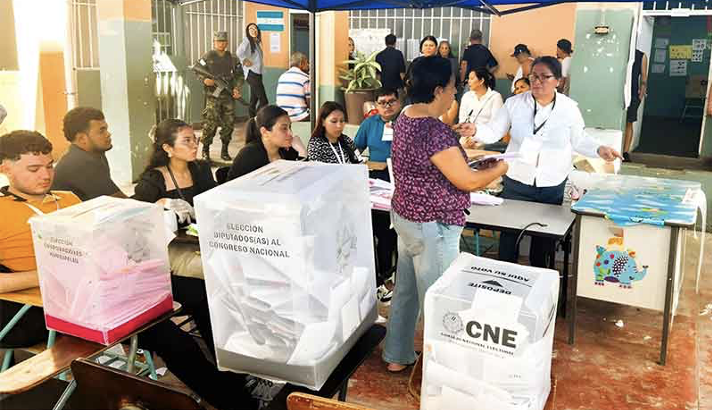
Hondurans at the polls on election day in 2021. [Source: Photo courtesy of Lucy Edwards]

The Dilemma of Emigration

In 2009, the year of the coup, approximately 1,000 Hondurans left the country seeking asylum. By the later years of the Hernández government (2015-2020), as many as three hundred people may have been leaving Honduras each day, a significant number out of the total population of Honduras (approximately 9.5 million). So far, this emigration flow has shown few signs of diminishing since the inauguration of the Castro government.

Hondurans in the United States during the past 12 years have been sending back remittances to Honduras that have totalled in excess of $4 billion a year, amounting to almost 20% of the country’s income.

This situation presents a dilemma for the Castro government. The flow of remittances that Hondurans in the United States have sent back to Honduras in recent years has been a substantial support for many Hondurans, relieving some of the economic pressure on some Honduran families. This is very real income for Honduras. When the Castro government was taking office early in 2022 and wondering how to finance both the country’s debt and meet its public social needs, remittances seemed like an important resource.

But this boost to the economy also comes with significant risks and costs. Remittances depend on several factors not under the control of the Honduran government, including fluctuations in the U.S. job market and attitudes and policies toward immigrants in the United States. The flow of remittances is thus unreliable over time.

The cost of this flow of people out of Honduras is evident. It represents a significant loss of youth, energy and creativity out of the country—a negative flow of social capital. This social capital is one of the major resources Honduras must have and retain if the promises of transition and reform under the new government are to become reality.

Such a large emigration also represents yet another sign of the dependency of Honduras on the United States as its benefactor. The large emigration to the U.S. allows the United States to use immigration policy and the image of migrants as a weapon to control and hold Honduran governments accountable. The fate of Honduran e/immigrants becomes a bargaining chip in the relationship between Honduras and the United States.

The Administration’s Call to Action initiative promises millions of dollars to Honduras and other Central American countries to promote investment, attract foreign corporations and create jobs, supposedly to create conditions for Hondurans to remain in Honduras. But to receive this aid, it is clear that the Castro government must agree to do nothing to seriously alter or challenge the current dominance of foreign corporations and “business as usual.” To some Hondurans and foreign observers, this seems like the same failed policy again—or worse, a form of extortion.

There is also the serious problem of immigrant child labour in the United States. As the number of children and teenagers immigrating to the U.S. from Honduras and other Central American countries has exploded in the last few years, individuals posing as “sponsors” have trafficked children and teens into dangerous and difficult jobs, violating U.S. child labour laws and keeping these immigrant youth in debt servitude, as a February 26 report in The New York Times reveals.

Many of these young people are under immense pressure to make money to send home and to pay back their “sponsors.” Many die through work-related accidents or illnesses. So far, U.S. authorities and agencies charged with the welfare of immigrant children do not seem to have been able to gain control of the situation. All of this raises questions about the real value of remittances coming from child labour. Cynics point out that child labour is common in Central America, but that is another of the realities that the Castro government must work to change.
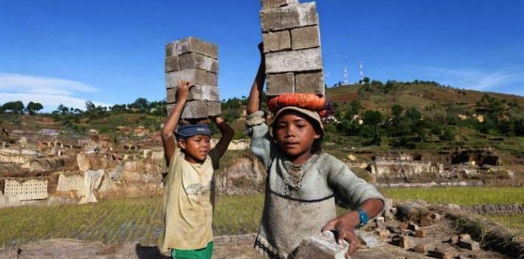
Child labourers in Honduras. [Source: rebellion.org]


The Problematic Relationship with the United States

For 150 years, the United States has influenced and sought to control the economic and political life of Honduras. In the age of U.S. expansionism and empire building, Honduras became a colony.

U.S. mining, and then banana and fruit company interests that gained such control over Honduran political life in the early 20th century were followed by the strengthening of relationships between the militaries of the two countries beginning in the 1950s. Civilian governments have come and gone in both countries, but the military relationship and collaboration has remained. The U.S. turned Honduras into its chief vassal state in the region, and the base for projecting U.S. military power. So dominant was the U.S. presence in the 1980s that Honduras was called the “USS Honduras,” and one Honduran congressman said, “Everyone knows Honduras is run by the U.S. Embassy. Honduras is an occupied country…”

Honduran governments, controlled by a small political and economic elite, found it to their advantage to keep the country “open for business,” especially for U.S. and other foreign investment.
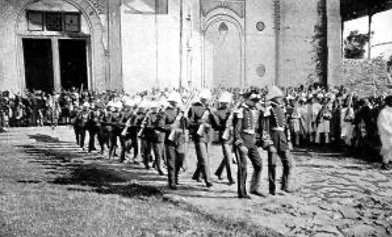
Honduran soldiers in the 1920s who were trained by the U.S. [Source: latinamericanmusings.wordpress.com]
The country alternated between periods of military rule and weak civilian government. Honduras was a nation with weak institutions and a powerful elite aligned with U.S. interests, despite the misgivings of many Hondurans about the loss of national sovereignty under the control of the U.S. Embassy.

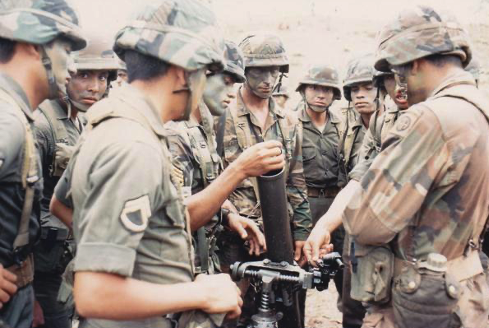
Honduran soldiers operate a mortar for members of the U.S. Army 82nd Airborne Division during a joint exercise, March 1988. [Source: revcom.us]
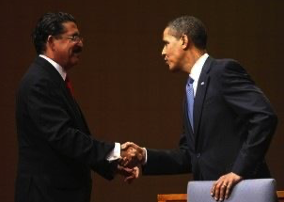
In the past decade, U.S. involvement in Honduran affairs has continued. Consider the response of the Obama administration to the coup in June 2009 that deposed Manuel Zelaya’s mildly reformist government. After a brief delay, the U.S. recognized the post-coup government in the interest of moving on and promoting “business as usual.” As the Hernández government became ever more mired in human rights abuses, corruption and violence, the State Department continued to certify that the country was making progress in democracy and human rights, ignoring the mountain of evidence to the contrary.

Obama shakes Manuel Zelaya’s hand at the Summit of the Americas not long before Obama backed a coup against him. [Source: latinamericanmusings.wordpress.com]

When Hernández finally left office last January, the U.S. requested his extradition on charges of drug trafficking. Many Hondurans breathed a sigh of relief, but they also saw this as another sign of the colonial-style relationship of their country to the United States. Some asked, “Why did we need the U.S. to indict Hernández? Why couldn’t our own institutions do it?”

Some Honduran human rights leaders argued that the U.S. indictment of Hernández, who was for so long a staunch U.S. ally, was an effort to clean an embarrassing image so that the exploitative reality could continue as usual with a cleaner, friendlier face.

The U.S. military presence in Honduras, the training of Honduran military in the U.S., and the joint military training exercises since the 1980s have been a part of the Honduran relationship to the U.S. for years and has expanded to include the U.S. Drug Enforcement Administration. Currently, the U.S. is promoting more “security” agreements with the Castro government.

Meanwhile, the U.S. is constructing a massive new embassy in the heart of the Honduran capital. The current embassy complex is already large, and the new one raises questions about its actual purpose in a country with a population of fewer than ten million. What agencies, offices and military units might be housed in this new embassy? The workers building it have been on strike for several months, with complaints of working conditions and owed pay against the contractor hired by the U.S.
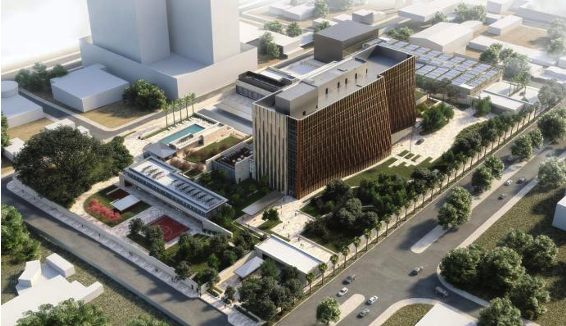
Blueprint of the new U.S. embassy compound in Tegucigalpa. [Source: ai-architect.com]

The United States is committed to the idea that it needs Honduras as one of its primary allies in the region, and one that is, conveniently, next door to Sandinista Nicaragua.

From the viewpoint of Washington, Honduras cannot be allowed to loosen its ties with the U.S. and move toward the sort of people-oriented political economy espoused by, for example, Nicaragua. This thinking—this fear—drives reaction to what the Castro government is trying to accomplish.


The Dilemma of Fractured Solidarity

Honduran human rights leaders have said repeatedly over the past decade that they welcome external solidarity, and that it can be of much help. But the pressures and dilemmas exerted on the Xiomara Castro government as it tries to move Honduras toward a more just and liveable society threaten to create yet another dilemma, one of fractured solidarity, both internal and external. Internal solidarity with the new government comes from the support of the Honduran people for the programmes of the new government and a stake in the general direction in which the government is leading the country.

While still strong, this support is strained by an increasing perception that the government cannot deliver on its promises, that it is internally divided, or worse, that it is making compromises with the very actors and forces of the old regime—police, military, big extractive and foreign businesses, the National Party, and the U.S Embassy. Internal solidarity can give way to disillusionment, passivity, emigration, or other reactions that further weaken the government’s support.

This situation also shapes external solidarity—the solidarity of groups and organisations in Europe, the United States, Canada and elsewhere. The image of a government that cannot seem to deliver the transformations it has promised; a country in turmoil, division, and violence; and a country whose government is forced to resort to drastic and seemingly repressive measures to “fast-track” some of its promises. All this can confuse and weaken the sense of solidarity from abroad.

What are people of good will outside of Honduras to think of what is happening in the country? A confusing and negative image is easily amplified by news media controlled or influenced by the forces (internal and external) that do not want change in Honduras. Perception and news media play critical roles in this shaping and fracturing of solidarity.

This sort of weaponization depends on: (1) portraying a distorted picture of friendly and legitimate criticism as a mass movement against the Castro government as a whole; (2) suggesting that the problems and “failures” of the Castro government are the result of its own policies rather than the entrenched legacy of the previous government aided by the U.S.; (3) erasing the historical context of U.S. control and interference in Honduran life; and (4) using terms such as human rights and democracy selectively to reshape and re-direct sentiments of support to serve the purposes of the U.S and other vested interests instead of the Honduran people.

By these means, solidarity can be weakened, diverted or invited to support narrow interests determined in Washington and foreign corporate board rooms without ever revealing these interests. Hondurans are wise to the ways that U.S. administrations and agencies and some of their own governments have tried to deceive, co-opt and suppress their aspirations. But the situation for Honduras at this moment raises concerns that both internal and external solidarity with the Castro government may become strained, if not endangered.


What Next?

The interrelated dilemmas facing the Castro government seem to present a “damned either way” situation. The bright light for Honduras is its people. They have a long history of organised, creative and peaceful resistance to the exploitation of their land and resources and the dangers to their national sovereignty. Honduras has very active and politically astute popular organisations and a strong and independent community of defenders of human rights, local communities and the environment. Their election of the new government was another powerful action to take back their country.

At this precarious moment, what constitutes real solidarity with the Honduran people? For U.S. citizens whose primary responsibility is the actions of their own government, recognizing and working to change the role of the U.S. government and corporations in perpetuating the status quo of “business as usual” would be a primary expression of solidarity since it would address one of the primary obstacles to change in Honduras. Re-thinking the failed strategy of more foreign investment and foreign aid for large-scale extractive development in Honduras would help considerably.

Finding ways for consumer action, legal action and legislation to hold U.S. corporations and investors accountable for their practices in Honduras is a related form of much needed solidarity with the Honduran people.

Working for major reforms in immigration policy could be another form of solidarity for U.S. citizens. In this, it is worthwhile to work toward ending mechanisms and excuses for mass deportations of Hondurans and others (excuses such as Title 42).

The United States government continues to talk of “partnership” with Honduras, but the relationship is intrinsically one of dominance. After more than 150 years of assumed superiority by successive U.S. administrations, it will be a difficult challenge to significantly change this official attitude to one of real partnership. The heart of solidarity with Honduras will require a significant change in attitude and practice. The human people-to-people connection that animates solidarity will be a great asset in this effort. What happens to Honduras will tell us much about the future of Honduras, Latin America and the United States.
 

Honduran government faces US and corporate backlash

Readers of The Violence of Development updates must by now be used to the acronyms ICSID and ISDS after many years of following the case of Pacific Rim / Oceana Gold and the struggle against metal mining in El Salvador. For those who aren’t familiar with the sets of initials, they stand for:

ICSID: International Centre for Settlement of Investment Disputes – this is a branch of the World Bank, established to adjudicate between companies and governments when commercial and financial disputes arise between them.

ISDS: Investor-State Dispute Settlement.


After the change of government in Honduras from one that was run by organised crime and which invited transnational corporations to rape and exploit its natural and human resources to one that is relatively progressive in its attempts to make ‘development’ benefit Honduran communities, it was entirely predictable that the new government would soon find itself facing ISDS judgements from the ICSID.

In a NACLA Report, Karen Spring of the Honduras Solidarity Network (HSN) has written an account, titled as above, detailing and explaining what such settlement hearings and judgements mean for the now not-so-new Honduran government of Xiomara Castro. We are grateful to Karen for her permission to reproduce her account here in The Violence of Development website. The original article can be found at: https://www.hondurasnow.org/article-published-in-nacla-winter-2023/


By Karen Spring

As President Xiomara Castro’s administration works to mitigate the fallout of the post-coup years, transnational companies are lining up to sue the state for lost profits.

Seven men, all dressed in suits, gathered at an undisclosed location in Honduras, sitting around a table covered in a white tablecloth and decorated with small glass vases holding yellow flowers. At the head of the table sat Roy Perrin, the deputy chief of mission at the U.S. Embassy in Tegucigalpa, and to his right sat investor Erick Brimen, the CEO of a project known as ZEDE Próspera. A social media post about the meeting on X from the U.S. Embassy referenced the “investment climate” and “legal guarantees” for investors.

In reality, the men were meeting to discuss one of the most controversial projects advanced in Honduras under previous administrations, including those headed by former president and accused drug trafficker Juan Orlando Hernández (JOH).

The meeting took place on September 29, 2022, just 13 days after three U.S. companies involved in ZEDE Próspera notified the Honduran government that they would seek international arbitration under the Central America-Dominican Republic Free Trade Agreement (CAFTA-DR).


‘International arbitration’ before a World Bank controlled Centre for Settlement of Investment Disputes (ICSID)

A few months later, in December 2022, the three companies filed a $10.8 billion case against the Honduran state. Like other trade agreements, CAFTA-DR allows investors to sue states for monetary damages stemming from government decisions that could negatively affect corporate investments. The arbitration suit is based on claims that President Xiomara Castro’s decision to overturn the laws that gave birth to the Economic Development and Employment Zones (ZEDEs) allegedly threatened or eliminated ZEDE Próspera’s ability to return a profit.

And while ZEDE Próspera’s visit to the U.S. Embassy in Tegucigalpa would not per se impact the arbitration suit, the ZEDE investors were looking for ways to bolster their case and credibility. Given the U.S. Embassy’s powerful influence in Honduras and its growing critique of Castro’s policies in the name of defending the pro-business status quo, the Embassy was one of the most strategic places for them to seek support.


Minor Reforms and Increasing Opposition

After more than a year and a half in office, Castro, the first woman president of Honduras, is confronting an increasingly well-organised national and foreign challenge to her government’s power and political platform.

In the first year of her administration, the U.S. Embassy vocally showed its disapproval for initiatives that sought to undo the worst excesses of the governments that ruled the country following the 2009 coup.

As opposition grows, the government has been weakened and undermined by what President Castro has called “the eternal enemies of democracy and a few rotten allies.” Although Castro has made no specific reference to the role of the U.S. Embassy in these efforts, inside Honduras there is little doubt that Washington supports opponents of the democratically elected government and continues to help fund elements of the growing national opposition.

For instance, USAID has maintained support to the tune of $1 million per year for the vocal public-private National Anti-Corruption Council (CNA), which Castro’s government has called “an accomplice that remained silent” in the face of corruption during the post-coup years.

Despite the U.S. government’s stated commitment to addressing the root causes of migration, on the ground in Honduras its policies continue to oppose even the smallest reforms that threaten the economic interests of foreign companies and wealthy individuals.

In 2022, Washington publicly criticized President Castro’s new Energy Law, formally called the Special Law to Guarantee Electricity as a Common Good for National Security and as an Economic and Social Human Right. The U.S. ambassador to Honduras, Laura Dogu, and the U.S. State Department claimed that the law creates uncertainty by impacting foreign investment and eliminates private trade in energy.

According to Grahame Russell, director of the U.S.- and Canada-based human rights organisation Rights Action, U.S. opposition to the Castro administration is similar to that faced by other progressive governments in Latin America. “All governments, including Castro’s, make mistakes,” he said. “But no one can doubt the little wiggle room that the Castro administration and their proposed policies have before the wealthy elite and their allies, the U.S. and Canadian governments, try to stop and undermine them.”

While the United States worries about how the Energy Law affects investment, the Honduran government argues that the legislation is beneficial for Honduras’s poor majority. The law, which entered into force in May 2022, seeks to renegotiate energy generation contracts, expecting to save the Honduran state an estimated $23.5 million while providing energy subsidies to approximately 1 million Honduran households.

The renegotiation of contracts is much-needed— the state currently pays an exorbitant price per kilowatt to private energy generation companies. Most contracts were granted and signed when accused drug trafficker Juan Orlando Hernandez (“JOH”) was in office as president or head of the National Congress. Extensive corruption and illegal procedures surround at least a dozen of these contracts, according to Honduran organisations like COPINH (Civic Council of Popular and Indigenous Organisations of Honduras) and the Centre for Studies for Democracy (CESPAD).

Importantly, some of the major problems associated with the projects include human rights abuses and the companies’ failure to consult local communities affected by dam and solar energy initiatives. In short, the contracts have unloaded the increased cost of energy on poor Honduran consumers.


Corporate Collusion with a Narco-Mafia State 

After the investors behind ZEDE Próspera presented their $10.8 billion case (almost two-thirds of Honduras’s annual budget), several other foreign companies followed suit. As of early October 2023, eight other companies had submitted claims against the state of Honduras. That number does not include threats from others to present claims in the future or the few cases that had been filed against Honduras prior to Castro’s inauguration.

The impact of investor-state dispute settlement (ISDS) mechanisms sends a strong and chilling message. In the case of Honduras, between the United States’ strong messaging about President Castro’s policies impacting the “investment climate,” and a slew of ISDS claims filed against the state, the message is clear. If the government makes changes to the pro-business, narco-dictatorship’s policies, the global political and economic structures will seek compensation, working with all the tools at their disposal to limit the administration’s ability to make reforms.


From ‘odious debts’ to ‘odious investments’

In other words, by undoing odious investments—to borrow the term ‘odious loans’ from the debt justice movement—political leaders will be subject to political backlash, international shaming, and large fines. Alternatives will not be permitted.

According to Jen Moore, associate fellow with the Global Economy Program at the Washington-based Institute for Policy Studies (IPS), ISDS are neocolonial and extractivist at their core, and undermine national sovereignty of both governments and peoples’ local struggles.

“[ISDS cases] are part of the architecture of impunity with which transnational corporations, mostly from the Global North, seek to profit wildly and maintain their control over the natural commons and the economy, especially in the Global South,” she said.

The mere threat of having to make a million- or billion-dollar payout to law firms or corporations is just one component. The cases are a significant impediment for territorial defence struggles and the sort of changes that Hondurans envision for the future of their communities and country, added Moore.

As of early October 2023, the pending ISDS claims against Honduras are related to real estate, energy generation projects, highway and airport construction, finance, and last but certainly not least, ZEDEs. Although information surrounding all cases—as listed on the World Bank Group’s International Centre for Settlement of Investment Disputes (ICSID)—is limited, at least seven of the nine cases presented in the last year are linked to corruption claims and/or serious social and human rights conflicts in various parts of the country.

One such case involves solar energy projects based in southern Honduras. Three Norwegian entities—Scatec, a renewable energy company; Nor-fund, a state-owned development finance fund; and its partner KLP Norfund Investments, the largest pension fund in Norway—filed two separate ISDS claims against Honduras in 2023. The cases likely were presented after a failed attempt to renegotiate the energy contract under the new Energy Law. The three actors are involved in large solar energy projects in southern Honduras that have been linked to drug trafficking, murder, and criminalization of local land defenders.

One such solar project, Los Prados, has faced opposition since 2016. Since then, nearby communities arguing that they were not adequately consulted and that the solar farms affect their water and food supply have met criminalization. In April 2019, eight community leaders who were summoned by police as witnesses were arrested and accused of duress and damages (they were later released). In addition, at least one community leader active in the movement, Reynaldo Reyes Moreno, was murdered in November 2018. Honduran authorities at the time suggested that Moreno’s murder was unrelated to his opposition to the solar projects, but his community believes otherwise. No thorough investigation of his murder has been conducted.

The project involved improving an existing highway and installing toll roads in at least two places. Local residents in the cities of El Progreso and La Lima maintained a permanent protest camp at the site of one toll booth, and in 2017, all the toll booths were burned down during protests sparked by electoral fraud and the unconstitutional re-election of President JOH. After arguing that they were not properly consulted, local citizens and business owners refused to pay the tolls to use the road, which they argued was constructed with public funds prior to the concession.

Community leaders at the forefront of opposing projects subject to ISDS claims question why foreign companies that make deals with governments involved in illicit, criminal activities have the moral and political grounds to make multimillion-dollar claims for lost profits.

According to Miriam Miranda, the coordinator of the Black Fraternal Organisation of Honduras (OFRANEH), investors take advantage of institutional weakness derived in part from the infiltration of criminal interest in state institutions.

“International capital has no shame in investing and supporting a president involved in drug trafficking,” she said. “Foreign companies validated the narco-state and took advantage of the institutional weaknesses that provide a great opportunity to invest, avoid paying taxes, and have all the privileges they want.”

Miranda survived an assassination attempt in her home on September 19, 2023.


International Tribunals Enforce Dirty Deals

Debt justice movements use the term ‘odious debt’ to describe illegitimate debt incurred without the people’s consent, often by despotic regimes. The concept argues that debt incurred by a dictatorship should be seen as personal debt of that government, not of the state itself.

This idea, though typically used to describe debt and not necessarily contracts with foreign companies suing under ISDS, should be applied to Honduras, particularly in light of the billions of dollars of claims against the country.

Foreign companies that shook hands with JOH’s government should not be entitled to compensation that hinders future development and burdens Honduras and Honduran communities.

Although the Castro administration has not explicitly announced its position around all the ISDS claims against Honduras, the Presidential Commission in Defence of Sovereignty and Territory, formed in April 2023, announced in a press conference that Honduras would not participate in the international tribunal process related to ZEDE Próspera’s claim.

In a statement delivered by Minister of Finance Rixi Moncada, the Commission said: “[The claimants] view the [ZEDE Próspera] litigation as an opportunity to join [state] looting through false arbitration…In admitting this controversial arbitration, the ICSID as an international body is being negligent to national [Honduran] legislation from 1988…that requires companies to exhaust national remedies before seeking international arbitration.” Moncada insisted that companies involved in corruption would lose their cases.

Although the press conference only addressed the issue of ZEDEs, Honduras has, in at least one other case, refused to engage in international arbitration by virtue of not appointing an arbitrator. Although to date no official announcement has been made, this suggests that Honduras could decide not to participate in any of the arbitration processes.

President Castro’s administration has quickly learned the difficulties of proposing reforms that even remotely threaten national and foreign economic interests. The U.S. government, despite its rhetoric about supporting democratically elected governments, including Castro’s, has assisted in undermining many of her administration’s most ambitious reforms that simply attempt to roll back some of the post-coup policies.

Internationally, the ISDS claims against the state attempt to further deadlock Castro’s proposed changes and prop up the claims of foreign companies, many of which got involved with odious investments during JOH’s narco-dictatorship.

With about two and a half years remaining of her mandate, Castro faces an ongoing struggle to resist opposition to her proposals, while pushing to follow through on the policies her administration has pledged to champion.


Karen Spring is the co-coordinator of the Honduras Solidarity Network (HSN) and a PhD student at the University of Ottawa.

Karen Spring: karen@hondurasnow.org
https://www.hondurasnow.org/uscanadaontrial/

Trying to head off a coup in Honduras

Comment by Martin Mowforth

November 2024

Early in 2024, the President of Honduras warned of a potential coup d’état in her country. President Xiomara Castro is relatively progressive, although some would describe her as ‘mildly progressive’. Regardless of these descriptive labels, she represents a turn towards a search for justice for ordinary people in Honduras and a challenge, however mild, to the prevailing and domineering ideology of neoliberalism which during the last three Honduran administrations became synonymous with gangsterism and corruption.

A September 13 report by Wyatt Reed in The Grayzone states that the Honduran government has complained against the US for trying to spark a coup d’état in their country. The media outlet Insight Crime, which is funded by the US State Department, had released an eleven year-old video implying that President Xiomara Castro’s brother-in-law had dealings with men who later turned out to be drug traffickers. This led to public accusations that Castro was sitting down with drug dealers. It is thought that the US released this questionable evidence in anger at President Castro’s willingness to sit down with the Venezuelan government despite the severe and internationally illegal sanctions called by the US against the Venezuelan administration.

In turn, President Castro withdrew the extradition treaty between Honduras and the US government and drew the public’s attention to US propaganda efforts to bring down her government. Referring to threats made by the US Ambassador accusing the Chief of Staff of the Armed Forces and the former Secretary of Defence of being drug traffickers, President Castro said: “I ratify that the peace and internal security of the Republic are at risk. … The same dark internal and external forces of 2009 [the year of the coup against former Honduran President Manuel Zelaya], with the complicity of the national and international media collaboration, are reorganising in our country to carry out a new coup d’état that the people must repel!”

Wyatt Reed, 13 September 2024, ‘Us govt-backed media, activists behind attack on Honduran government’, The Grayzone

Early warning signals of yet another U.S. administration preparing yet another intervention in Honduras

We are grateful to Rights Action for so much of their reporting which is generally uncovered elsewhere, and is especially absent from the UK. Their March 10th report covers the external pressures exerted on Honduras by US corporations and the US political establishment.

Below:

  • Article: “Trumpists Agitating To Coup Honduras
  • Link to “The Corporate Assault on Honduras” report on global companies and investors using “free trade” arbitration mechanisms to extort governments
  • Links to other relevant background material.

*******

Trumpists Agitating To Coup Honduras

By Nate Bear, Mar 05, 2025

https://www.donotpanic.news/p/the-trumpists-agitating-to-coup-honduras

Prospera, a Peter Thiel-backed crypto ‘city’ running unregulated medical experiments on a Honduran island may very well be the spark for a US coup against Honduras this November. Prospera, if you haven’t come across it before, is a libertarian mini-state which is funded by crypto investors and tech oligarchs including Thiel and DOGE recruiter Marc Andreessen.

Operating outside of Honduran law and run by a small council of venture capitalists and crypto libertarians who set their own laws and regulations, Prospera is under threat from the president of Honduras, Xiomara Castro, who wants to strip it of its special legal status. Castro says that Prospera is an affront to Honduran sovereignty and should never have been given the go-ahead in the first place, a go-ahead granted by a right-wing businessman who became president after Castro’s husband was ousted in a military coup backed by the US. After Castro won power back from the right in 2021, she made it a priority to rein in what William Gibson might call an outlaw city.

The tech oligarchs behind Prospera fought back at Castro’s attempts to shut them down and are suing Honduras for billions of dollars. The fight has made headlines in recent months, not least because the damages Prospera is seeking could conceivably bankrupt the country. Almost no attention, however, has been paid to how this fight is turning Prospera into a cause célèbre for influential Trumpists who have begun calling on this American outpost to be defended against Castro’s socialist government.

One prominent Trumpist to latch onto Prospera as a symbol of everything right about American capitalism and adventurism and everything wrong about Latin American socialism is Roger Stone, a 50-year confidante of Trump and his political hitman.

In a blog post titled ‘How President Trump Can Crush Socialism and Save a Freedom City in Honduras’, and written with all the fluency of a neurolinked gibbon, Stone says that the future of Prospera has ‘major implications for US policy and the future of freedom throughout the world.’

He goes on to say that
‘Trump has quite a bit of leverage at his disposal to upend Castro’s fledgling regime’ and that ‘Honduras could be liberated and Castro’s regime upended without firing a single shot or deploying a single troop.’

To achieve this he says Trump should pardon the disgraced former president, Juan Orlando Hernández, colloquially known as JOH, who is in prison in the US indicted on drug trafficking charges, and back him in the November elections.

Another high profile Trump ally to position the fight for Prospera as being in America’s interests, is Erik Prince, the former CIA assassin and founder of US state department mercenary contractor Blackwater. In a November tweet Prince said that the threats faced by Prospera should be ‘intolerable for the Trump administration’ because of the strategic importance of Honduras and the fact Prospera is trying to ‘bring civilisation’ to Honduras.

(Charter/network/free cities as an effort to reclaim an imaginary of western civilisation is a common theme among tech-crypto libertarians).

If Erik Prince, a man with a history or robbing and looting impoverished states, has you, an impoverished state in his sights, that’s an ominous sign.

Prince’s post was retweeted by the great and good of Prospera including Niklas Anzinger. Anzinger runs Infinita City, the arm of Prospera focused on extending the human lifespan and running unregulated medical experiments to this end. (If you’ve watched the Netflix documentary about Bryan Johnson, the tech billionaire who wants to live forever, and who I wrote about here following his rough brush with covid, you might remember he visited Prospera to get injected with a novel gene therapy not available anywhere else in the world).

Anyway, Anzinger has tweeted a couple of times about the upcoming elections in Honduras. He responded to Stone’s January blog post about ousting Castro by saying ‘we’re working on it!’, and just the other day tweeted ‘we expect the next elections in Nov 2025 to lead to a friendly administration that affirms our rights.’

Adding to the sense that something is being cooked up was the founder of Prospera, Erick Brimen, thanking Prince for his intervention and saying he was excited for some of Prince’s “magic” to come in 2025.

Weird. Maybe these are just things you say. But maybe not.

Another group to have visited Prospera in recent weeks are Republicans for National renewal, a MAGA-aligned group founded by Mark Ivanyo, a former staffer in Trump’s first term Department of Justice. They touted Prospera as ‘similar to President Trump’s proposed Freedom Cities’ and also took aim at Castro, saying Prospera was ‘a bastion of pro-Americanism, economic freedom & Bitcoin acceptance in socialist Honduras.’

Prospera was also visited last week by Cremieux, an anonymous twitter account regularly retweeted by Elon Musk (and likely run by more than one white crypto-libertarian type) that helps set the libertarian discourse.

Given these links, it’s inconceivable that Trump hasn’t heard about Prospera and the threats to its existence. Marco Rubio, a man aggressively hostile to anything that looks or smells like socialism in Latin America, almost certainly has as well. It was telling that he didn’t bother visiting Honduras on his recent trip to Latin America, his first outside the US.

Prospera is just one of a number of crypto-based, parallel institution states-within-states that tech oligarchs are trying to establish around the world. With Trump having embraced crypto libertarians as his ticket back to power, we should expect him to defend and advance their interests, not least because of their potential, as in the case of Prospera, to be the tip of the imperial spear in the developing world.

The combination of Rubio as head of the state department and Prospera libertarians in the White House is extraordinarily dangerous for Honduras. The US has always had strategic incentives to see left-wing candidates defeated in Latin America, but now it has very personal incentives as well.

Marc Andreessen, who has been hanging out with Trump and recruiting for DOGE, and his co-investor Thiel are both heavily invested not just financially in Prospera through their VC fund Promonos, but ideologically in the concept of parallel states-within-states. For them to see Prospera fall would be a double hit.

For developing countries like Honduras, Prospera demonstrates the dangers of allowing libertarian American capital the freedom to establish shadow legal entities within your territory. They might provide a few low-paid service industry jobs, but if they turn on you, they’ll threaten to bankrupt you. Or coup you. Or both.

Then there are the moral questions that arise from allowing billionaires to operate zones of exit outside regulatory oversight.

Biohacking and longevity experiments are a central component of Prospera, and regular articles on longevity research now pop up in traditional media, normalising the field. But longevity researchers often appear dangerously enamoured with eugenics.

For example, a presentation this week at Prospera by a professor from George Mason university said that selecting embryos for IQ might soon be possible and could boost global innovation by hundreds of thousands of dollars. This is an outrageous, preposterous statement that rests on two fallacies: IQ exists as a measurable metric (it doesn’t) and creating economic growth (by optimising humans) should be the singular goal of humanity. This is essentially an argument for eugenics-powered capitalism.

These people are monsters and the dangers of allowing them ever-expanding control of our institutions are obvious.

There is also a massive irony at the heart of Prospera.

The network state ideal is motivated in large part by the bird-brained desire to exit the political and establish zones of pure apolitical capitalist freedom outside of neoliberal bureaucracies.

Yet in Prospera, these crypto coiners have found themselves at the centre of political intrigue and have had to resort to suing Honduras through the investor-state dispute settlement, a little-known but central component of global capitalism’s neoliberal bureaucracy.

That feeling when you’re forced to turn to neoliberalism’s bureaucracy to save yourself from neoliberalism’s bureaucracy eh?

Which really tells us everything you need to know. Crypto libertarians are the neoliberals they pretend to reject. Plain old capitalists, modern-day colonisers trying, like every coloniser before them, to bend the world to their will.

The outcome in Honduras will go some way to determining whether they succeed.

Please share and re-post this information


+++


Further background

Corporate assault on Honduras

Honduras Solidarity Network, February 18, 2025

Honduras faces an unprecedented legal siege: 15 multimillion-dollar lawsuits by transnational corporations seeking to impose their will over the country’s sovereign decisions. The video “The Corporate Assault on Honduras” (produced by TerraJusta, Transnational Institute, Honduras Solidarity Network and Institute for Policy Studies) reveals how international arbitration mechanisms are being used to blackmail the country and block policies in favour of its people.

https://mailchi.mp/rightsaction/never-ending-us-government-corporate-interventions-in-the-americas


“No country in Latin America has remained free from the shadow hanging over them.

The shadow of the United States. The shadow of the Monroe Doctrine.”

General elections in Honduras: Emerging risks for land defenders

We have included the following short extracts from the monthly news alert of the Aguán valley to illustrate the local effects of the corrupt election held in November 2025. They also illustrate the mechanisms by which power can be deployed to threaten those who attempt to defend their land, environment and community.

Tocoa, Colon, Honduras – During the month of November, general elections were held in the country. Prior to the elections, the Agrarian Platform issued a statement warning of a plan to create the political conditions for an electoral coup, one that would favour the return to power of the business, political, and criminal sectors that had benefited from the 2009 coup and the narco-dictatorship. Days later, popular organisations spoke out against US interference in the electoral process and called for the consolidation of popular unity to defend the self-determination of peoples and territories.

Furthermore, the modus operandi that enables criminalization, exploitation, and plunder in Colón was once again evident. While the mayor of Tocoa, Adán Funez, hands over land titles to people who administer social media platforms which harass leaders, campesino communities, and environmental defenders, Funez is also attempting to remove councilman Leonel George, known in the region for his environmental advocacy, from office.


Latest News

Adán Fúnez Donates Land to Social Media Page Administrators: An investigation by Contracorriente reveals that the mayor of Tocoa, Adán Fúnez, donated land to administrators of social media pages that conduct smear campaigns against leaders and grassroots, campesino, and environmental organisations in Tocoa. Among the beneficiaries are Héctor Madrid, a journalist, correspondent for several media outlets, and administrator of the Noticias de Colón HN Facebook page, and Erlin Henríquez, an evangelical pastor who also administers pages and groups on Facebook. Both received land in the municipality of Tocoa between 2015 and 2016. These same individuals have disseminated content defending various people with alleged ties to organised crime, including the criminal group Los Cachos.

Solidarity with Councillor Leonel George: On November 13, organisations demonstrated in solidarity with Councillor Leonel George, a member of the Tocoa Municipal Committee for Common and Public Goods, who, along with three other councillors, has been summoned to a hearing by the Ministry of the Interior and Justice. The hearing was requested by the mayor of Tocoa, Adán Fúnez, who sought their removal from office as municipal councillors due to their absences from three consecutive regular sessions.

In an interview, Leonel George described the situation as “selective persecution” and “revenge” on the part of the mayor, because the four councillors summoned to the hearing were the same ones who had denounced Adán Fúnez for abuse of power.

Popular movements speak out on elections: On November 27, popular organizations and movements in Honduras issued statements regarding the general elections, reaffirming their independence and commitment to defending human rights and land, and warning of the serious risk posed by political forces seeking to return to authoritarianism, corruption, and dispossession. On November 28, the campesino movement organized in the Agrarian Platform warned of the development of media campaigns and the creation of political conditions aimed at justifying an electoral coup in the general elections.

Trump’s interference invalidates the presidential election in Honduras

In Imperialism, by John Perry

08/12/2025

We are grateful to John for his permission for us to reproduce his article in the TVOD website.

An extraordinary catalogue of US interference – amounting to an electoral coup – may have destroyed what was already a struggling democracy in Honduras. Trump has succeeded in closing the door to progressive government and in all likelihood his preferred neoliberal candidate – previously trailing in many opinion polls – will be declared president when the count eventually finishes.

While Washington’s aversion to foreign interference in its domestic elections verges on paranoia, the gross hypocrisy which runs through its foreign policy leaves it free of any compunction when meddling in other countries’ elections, especially in Latin America. Perhaps no country has greater recent experience of this than Honduras. Although most accounts of this meddling begin in 2009 with the ousting by army officers of its democratically elected president, Mel Zelaya, in truth US dominance of the country has a much longer history, as I described at the time.

The US refused to designate Zelaya’s toppling as a “military coup” or to back international calls for his rapid return to office. Washington then backed all the post-coup governments, including those established by Juan Orlando Hernández when his National Party “won” two highly manipulated elections. Rampant corruption by him and his predecessors ensured that Honduras became a “narcostate.” Nevertheless, US administrations embraced Hernández as a prime ally in the war on drugs up until the point when he left office, was extradited and committed to 45 years in a US prison. Only the large majority won by the Libre party’s Xiomara Castro in the 2021 election, and the fact that Hernández had become a liability, temporarily frustrated Washington’s customary ability to get the Honduran president that best suited its interests.

Castro’s government only partly fulfilled its progressive aims, not least because of the continuing power wielded by Honduras’s often corrupt elite, a judicial and security system still strongly subject to US influence, and social media campaigns which often originated in Washington. Opinion polls showed that Castro’s chosen successor as Libre Party candidate, Rixi Moncada, would be in a close race with the right-wing candidates of the two traditional parties, the Liberals’ Salvador Nasralla and the National Party’s Nasry Asfura. Trump favoured Asfura, effectively the successor to Juan Orlando Hernández, as the candidate most attuned to his policies.

The fact that the November 30 election took place at the height of the US military build-up in the Caribbean was itself a crucial ingredient in determining the outcome. Both right-wing candidates were able to warn Hondurans that a vote for Libre would be an invitation to the US military to turns its guns on them. Trump emboldened them by asking on Truth Social, “Will Maduro and his Narcoterrorists take over another country like they have taken over Cuba, Nicaragua, and Venezuela?” According to him, a vote for Asfura would ensure that Honduras did not face the same potential fate as Venezuela. “Tito and I can work together to fight the Narcocommunists,” he added. “I cannot work with Moncada and the Communists.” Nor, apparently, could he even trust Nasralla, whom he described as “borderline communist.”

The president then trumped this statement by declaring that only if Asfura won would US aid for Honduras continue. “If he doesn’t win, the United States will not be throwing good money after bad,” he said. When Nasralla appeared to have edged ahead of Asfura, in a close count, Trump said that it “looks like Honduras is trying to change the results of their Presidential Election,” adding, “If they do, there will be hell to pay!” Then, in a night “marked by technical failures and tension in the results system,” the count suddenly gave the lead to Asfura. The International Observation Mission of the American Association of Jurists asserted that Trump’s intervention “has placed the legitimacy of the democratic process in crisis.”

In an even more extraordinary move, Trump announced that he would be pardoning the disgraced former president Hernández, who has indeed since walked free from prison. A move that might have harmed the National Party appears instead to have been an astute boost to Asfura’s campaign, given that many of his supporters still idolize Hernández and regard Asfura as an inferior leader. However, Mike Vigil, a former senior official in the US Drug Enforcement Agency, told the Guardian that pardoning Hernández “shows that the entire counter-drug effort of Donald Trump is a charade.” Activist and author Dana Frank told the Guardian that “his repressive, thieving, dictatorial history, backed by the United States year after year, has evaporated from the story.”

Another, very effective but little publicized intervention appears to have taken place, if Rixi Moncada’s claim in an interview with Telesur is correct. According to her, huge numbers of the 2.5 million Hondurans who receive remittances from family members in the US were warned that, if Libre won, they would not receive their December payments. The magnitude of the threat (whether or not it could have been carried out in practice) is indicated by the fact that remittances account for a quarter of Honduras’s GDP. It seems possible that many poor households’ votes, which might have gone to Libre, didn’t – because of text messages sent directly to their phones.

That electoral fraud would again favour the US-supported candidate was indicated in the run up to November 30 by leaked audios implicating the National Party’s representative on the national election council. The council’s Libre representative, Marlon Ochoa, who denounced that planned fraud, has now published a detailed account of irregularities since counting started, which he claims invalidate 86 per cent of polling returns. Indeed, at the time of writing, following a week of technical problems in vote counting, there is still no official winner.

Rixi Moncada harshly questioned the silence of the electoral observation missions from the Organization of America States and European Union, which she accused of deliberately omitting any reference to Trump’s interference in their bulletins on the conduct of the election. “So far they have not commented on the intervention of the U.S. president in their reports,” Moncada claimed, noting their attitude “borders on complacency.” New York Times interviews with Hondurans showed clearly that Trump’s comments influenced their votes. Mark Weisbrot, of the US Centre for Economic and Policy Research, pointed out that his interventions were “a violation of Article 19 of the Charter of the Organization of American States, to which the United States is a signatory.”

Emboldened by his apparent success in defeating “communism,” even if (at the time of writing) he may not yet have secured the victory of his preferred neoliberal candidate, Trump has gone on to publish his own “corollary” to the century-old Monroe Doctrine, endorsing its claims to a unique US sphere of influence covering the whole region. Echoing the 1904 corollary to the doctrine issued by President Roosevelt, which declared that the US would be a “hemispheric police power,” Trump says he is “proudly reasserting” control over “our hemisphere,” guarding the American continents “against communism, fascism, and foreign infringement.”

Nothing could be a clearer manifestation of what has been called the “Donroe Doctrine” than the military build-up in the Caribbean, which provided the threatening backdrop to the final weeks of the Honduran election campaign. As Roger Harris and I noted in a recent article, the deployment of one-fifth of US maritime power is aimed not just at Venezuela, but at starting a wider domino effect in the Caribbean basin. In the aftermath of November’s election night in Honduras, the first domino appears to have fallen.

John Perry has written for The NationLondon Review of BooksGuardian, Council on Hemispheric Affairs, CounterPunchGrayzone and other outlets. He is based in Masaya, Nicaragua.

Trump’s pardon of an ex-Honduran president is shocking.

So is the history of US support for him. Obama, Trump, and Biden stood by their man in Tegucigalpa for the eight vicious, destructive years he was in power

By Dana Frank, 6 Dec, 2025

The Guardian

https://www.theguardian.com/commentisfree/2025/dec/06/trump-honduras-juan-orlando-hernandez reproduced by Rights Action on 8th December 2025.

Since President Trump first announced the pardon of former Honduran president Juan Orlando Hernández last Friday, the media has been wading through the long list of criminal acts that led to Hernández’s 2024 conviction for drug trafficking, money laundering and arms dealing.

Trump’s outrageous pardon is being contrasted with his unlawful, aggressive attacks on boats allegedly trafficking drugs for the government of Venezuela.

Missing from the narrative, though, are the other illegal acts committed by Hernández that weren’t about drug trafficking and thus didn’t fall under the justice department’s anti-drug mandate when it charged and convicted him in the southern district of New York. Many are the crimes of Juan Orlando Hernández, and ruinous.

And long is the history of US support for him in full knowledge of those crimes. Presidents Obama, Trump and Biden all stood by their man in Honduras for the eight vicious, destructive years he was in power. They ignored his drug connections, supported the military and police that kept him in power through state terror, and countenanced his illegal re-elections. Hernández was only able to rise to power, and stay there, because of the United States government.

When Hernández was a member of congress he was part of a committee that approved the 2009 military coup that deposed the democratically elected president Manuel Zelaya. As president of congress in 2012, he led the “technical coup” in which four out of five members of the constitutional branch of the supreme court were illegally and replaced with his loyalists.

Hernández won the presidency in a dubious 2013 election. Two years later it was revealed that he and his party stole as much as $300m from the national health service to pay for their campaigns, bankrupting it.

Under his watch, the criminal justice system crumbled; gangs, violence, extortion and murder proliferated.

In 2017, Hernández ran for re-election even though the constitution strictly forbade it. When the majority of the results had been counted in that election and his opponent was clearly ahead, Hernández’s officials shut down the computers, then announced a week later that he had won by 1.7%.

In response, outraged Hondurans peacefully protested and Hernández’s security forces used live bullets for the first time in decades, killing at least 20 protesters and bystanders.

All those years Hernández was also in bed with drug traffickers. As the brave prosecutors of the southern district of New York (SDNY) have shown, he accepted huge sums from drug traffickers, including a million dollars from the famous Mexican cartel leader Joaquín “El Chapo” Guzmán. Memorably, Hernández promised to “shove the drugs right up the gringos’ noses”.

But when Hernández overthrew the supreme court in 2012, the US government looked the other way. When widespread violence erupted in the run-up to the 2013 election that Hernández falsely claimed to have won, and a recount was barred, Obama’s secretary of state, John Kerry, blessed the outcome and praised the Honduran government “for ensuring that the electoral process was generally transparent, peaceful, and reflected the will of the Honduran people”.

When Hernández ran for re-election in 2016 in complete violation of the Honduran constitution, the US embassy in Tegucigalpa announced: “The United States does not oppose President Hernández or others from presenting themselves for re-election according to Honduran democratic practices.”

And when Hernández went on to steal the 2017 election, the state department, under Trump, congratulated him on his victory.

In 2015, hundreds of thousands of people erupted in peaceful anti-corruption demonstrations demanding “FUERA JOH!” (Hernández Out!). Days after the biggest single march in the capital, the US ambassador, James Nealon, stood next to Hernández in a matching guayabera shirt at the embassy’s big Fourth of July party and announced very deliberately: “Relations between the United States and Honduras are perhaps the best in history.”

Soon after, Biden, then the vice-president, launched the “Central American Alliance for Prosperity”, rushing $250m to aid the Honduran government.

During all these years the US also poured tens of millions of dollars into the support of the Honduran military and police, shared intelligence with its military, and worked closely with figures now documented to have been collaborating with drug traffickers. Former general Julián Pacheco Tinoco, minister of security under Hernández, for example, was named explicitly during Hernández’s trial. It’s implausible to think the US wasn’t well aware of Hernández’s narco connections all these years, given its vast intelligence apparatus including the CIA, the Defense Intelligence Agency and the Drug Enforcement Administration.

Yet in 2017, Gen John Kelly, former head of the United States Southern Command and about to become Trump’s chief of staff, referred to Hernández as a “good friend” and a “great guy”. Adm Craig Faller, head of the United States Southern Command, after presenting a medal in December 2020 to the chief of Hernández’s armed forces in December 2020 announced: “Honduras is a trusted partner in regional efforts to combat illicit traffickers.”

Beginning in 2015, 80 Members of Congress and a dozen senators demanded that the US suspend all security aid to Honduras, but Obama, Trump and Biden kept the money flowing nonetheless.

Thanks to Trump’s shocking pardon, Hernández’s drug crimes are now more well known than ever. But the rest of his repressive, thieving, dictatorial history, backed by the United States year after year, has evaporated from the story.

Who will be held accountable up north for supporting him all those years, in yet another chapter of repressive US intervention in Latin America? Or will Hernández’s full criminal history – and US support for him – be swiftly forgotten?

Dana Frank is Professor Emerita of History at the University of California, Santa Cruz. A well-regarded senior historian, she is the author of many books on labour, women, and social justice in the US and Honduras.

The challenges facing the new Honduran government

June 28, 2022

June 28th passed this year (2022) as the 13th anniversary of a 2009 coup d’état that drastically changed Honduras into a country run by and for organised crime with the approval and active support of the US and Canadian governments. The Honduras Solidarity Network (HSN) – www.hondurassolidarity.org/ – outlines some of the background below. We are grateful to Karen Spring of the HSN for her work gathering and providing information about happenings and developments in the country.

The US supported and benefitted from the years of aggressive and violent neoliberalism that would increase the extractive economy based on mining and hydroelectric projects, further land grabbing by agribusiness companies and oligarchs, and ensure subservience to US foreign policy and wars. This led to the near-collapse of the privatized and plundered public education and public health systems, murders by death-squad groups and security forces of activists across the country, and a terrible increase in poverty, crime and general violence. The eight years (2014-2022) of the narco-dictator Juan Orlando Hernández (JOH) were also marked by the forced displacement of millions of Hondurans internally and hundreds of thousands forced to leave Honduras altogether.

The election in November 2021 and inauguration in January 2022 of President Xiomara Castro of the Liberty and Refoundation (LIBRE) Party in coalition with smaller opposition parties is the victory of 13 years of resistance by the Honduran people.

During the first five months of the new government, many important promises have been kept and progress made, but the obstacles to reforms – let alone deeper changes – are enormous. The narco-dictatorship’s economic and political structures are deeply entrenched, including having representation in Congress and among the government civil service employees. The judges at all levels of the court system are still those appointed by Juan Orlando Hernández. Xiomara Castro inherited a country that is nearly bankrupt and in debt, facing forces that oppose change.

The United States and Canadian governments and international financial institutions are among the forces against ‘too much’ change. The US seems to have realised that the JOH narco-dictatorship had become too exposed and untenable and that the opposition to JOH in Honduras had grown too broad to directly challenge. It recognised that Xiomara Castro won the election and sent Vice President Kamala Harris to the inauguration. From day one, it has also pressured the new government to limit its independence from US international interests and even to limit its plan to dismantle the neoliberal and extractive economic model.

The Honduran social movements: the organisations of the Indigenous and Black peoples, small farmers, workers, women, and students, are supporting their new government while continuing to fight for their proposals and the promise of refoundation in Honduras. As international solidarity and human rights organisations in the US and Canada, we continue to stand with the social movements. We continue to tell our governments and corporations to stop interfering, to stop using money and a military presence to control and limit Honduras’ progress in undoing the damage of the past 13 years.

The HSN is working on a campaign to support debt relief for Honduras that is urgently needed for the project of rebuilding and refounding the country after 13 years of disaster. It also supports the ‘Justice for Berta’ campaign led by COPINH, which is fighting to ensure that all those involved in her assassination are brought to justice. To sign up for the HSN’s  informational list serve, email: honsolnetwork@gmail.com

International Commission Against Impunity to Be Installed in Honduras

The following news item from Telesur may be short but is potentially highly significant for the development of Honduras and for the country’s ability to move out of the culture of corruption and state violence that has been the hallmark of the Honduran government since 2009 when a US-backed government of organised crime took over the running of the country.

Keywords: Honduras; corruption; narco-trafficking; MACCIH; CICIH.

By Telesur, 26 February 2022


The predecessor of the CICIH [known as MACCIH, Support Mission Against Corruption and Impunity in Honduras] was expelled by the Hernández regime when the regime was  exposed and investigated.
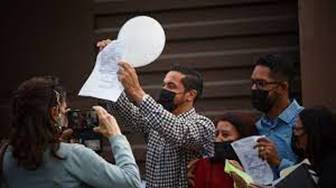
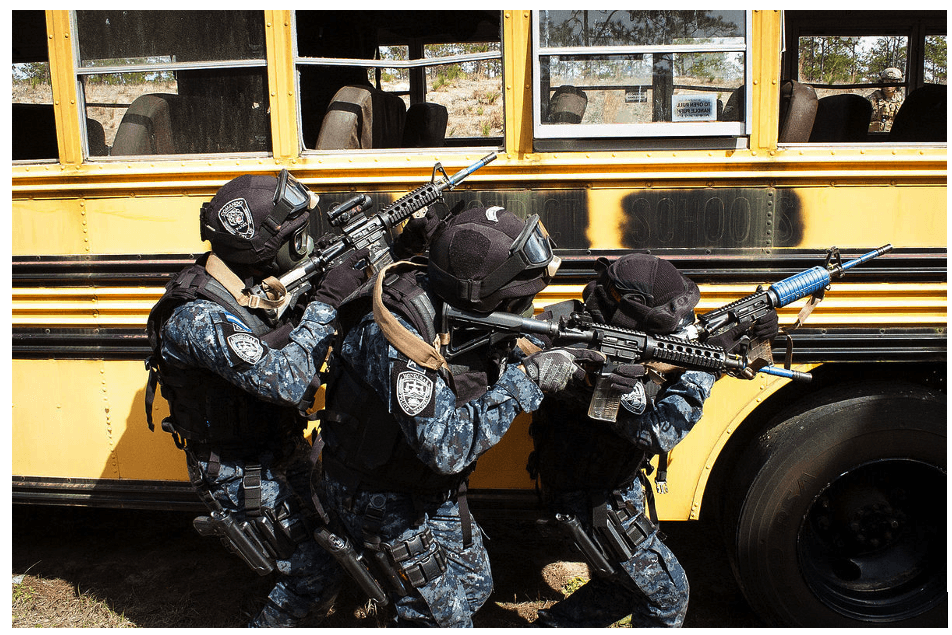
The United Nations confirmed President Xiomara Castro’s request to install the International Commission against Impunity (CICIH) in the framework of the fight against corruption.

The process will take a period of time that the UN has not yet stipulated, but they did offer a positive response to the request.

The 12-year management of the national party will be reviewed and exposed by this commission; which seeks to bring the corrupt to justice.

The predecessor of the CICIH was expelled by the Juan Orlando Hernández regime when the corruption was exposed and investigated.

This is the second attempt by the Honduran people to get high profile dishonest people jailed.


End of a Narcostate?

By John Perry

LRB Blog, 26th November 2021

We are grateful to John Perry for permission to reproduce his 26th November blog for the London Review of Books. John lives in Masaya, Nicaragua and several of his writings can be found in The Violence of Development website. The London Review of Books (LRB) is a British literary magazine published twice a month. Its blog feature can be found at: https://www.lrb.co.uk/blog/

Joe Biden has a Central America problem. Countries that turned reliably neoliberal after the ‘small wars’ of the 1980s have become unwieldy again. After sixteen years of neoliberalism, Nicaraguans returned Daniel Ortega to power in 2007 and re-elected him this month in a vote which Biden dismissed as a ‘pantomime’. In El Salvador, Nayib Bukele, elected in 2019 with Trump’s blessing, has been described as a ‘narcissistic dictator’ by a senior Democrat because of his growing authoritarianism, secret deals with violent gangs, making bitcoin legal tender and fostering links with China. Riding high in opinion polls, he now calls himself ‘the world’s coolest dictator’.

In Honduras, Biden’s problems stem from the period when he was vice-president and the mildly reforming President Zelaya was ousted in a military coup. Neoliberal government was restored, but the corruption and drug-trafficking created a narcostate, led since 2014 by Trump’s confidant Juan Orlando Hernández. When Hondurans voted to end JOH’s mandate in 2017, the US ensured that a rigged result kept him in power.

JOH is finally standing down as Hondurans go the polls again on Sunday. His security in retirement depends on the National Party retaining control so he can avoid extradition to the United States, where his brother has been condemned to life imprisonment for drug-trafficking. The party’s candidate, Nasry ‘Tito’ Asfura, currently the mayor of Tegucigalpa, is under investigation for the alleged embezzlement of $1 million. He is likely to protect JOH if he wins.

He may well lose, however. Until last month, the National Party’s core vote of about 20 per cent looked sufficient to give Tito victory, but two opposition parties have since united. Salvador Nasralla, who should have won the last election, gave way to Xiomara Castro and the last poll put the new alliance on 38 per cent.

Biden would ideally prefer a result that curbs the narcostate, but he’s unlikely to want that to come from a Castro victory. The co-ordinator of her Libre party is her husband, Mel Zelaya, the victim of the 2009 coup. Castro has carefully avoided any impression of radicalism, but while she appears to have won trust among the electorate she is unlikely to have won Biden’s. In a move suggesting heightened US concern, it nominated a full ambassador to Honduras after five years without one.

The election period has already been marked by violence, with the deaths of around thirty congressional or local candidates, mainly from opposition parties. The perpetrators are unlikely to face the law. In the case of Honduras’s most notorious political murder, the killing of Berta Cáceres in 2016, only one of those who commissioned the crime has been convicted and he has still not been sentenced. Cáceres’s daughter Olivia Zúniga, a Libre congresswoman standing in the election, was almost murdered in October when four men broke into her house and tried to strangle her. Fewer than 3 per cent of Hondurans are said to recognise the country as a ‘full democracy’.

Hundreds of fake Twitter accounts have spread authentic-looking lies about Castro; fake opinion polls appear alongside real ones; 300,000 voters still don’t have the identity cards they will need at polling stations; police seized a ‘Molotov cocktail’ factory run by gangs planning to disrupt the voting; a shoot-out during a Liberal Party rally left at least one person dead; a presidential candidate hostile to JOH was arrested along with his wife and mother-in-law; Asfura received a ‘climate positive’ award at COP26 in Glasgow despite being closely associated with deforestation and attacks on environmentalists.

In the year since Biden was elected president, the number of people apprehended at the Mexican border has reached a record high of 1.7 million. A fifth of them came from Honduras. The narcostate is also a failed state. It failed to deal with the pandemic and has Central America’s highest Covid death rate. It failed to respond to two major hurricanes last year, with many people still left homeless. Seven in ten households live in poverty despite $20 billion supposedly being devoted to tackling the problem since the last election (after publishing the poverty figures, the national statistics institute hurriedly deleted them).

Even conservative media in Honduras are now proclaiming Castro’s likely victory, but many people still expect another rigged election. That could lead to massive demonstrations which, as in 2017 when at least 24 people died, would be violently repressed. Biden would have a compliant partner in Asfura but he would still be running a narcostate. And many more Hondurans would head for the Rio Grande.


Comments

27 November 2021 at 12:42pm

Delaide says:

The Cold War is over, why would Biden be so keen to keep Honduras ‘compliant’? Especially so when poor governance by the party in power has created such problems for him at the border, not to mention the narcotics.

27 November 2021 at 1:08pm

John Perry says: @ Delaide

Just because US policy makes no sense, that’s no guarantee they won’t pursue it, unfortunately. They are sanctioning the country in the region most committed to social development (Nicaragua), regardless of the likely consequences for migration northwards.

Note: Although at the time of writing not all the results of the Honduran election are in, it appears that Xiomara Castro of the Libre Party had defeated Nasry Asfura of the National Party by a relatively wide margin. It seems unlikely that the National Party will be able to steal the election fraudulently as it did in 2017.


Edwin Espinal and Raúl Álvarez, Honduran political prisoners – all charges dropped

In December 2019 we included in this section of The Violence of Development website a Honduras Solidarity Network article about Honduran political prisoner Edwin Espinal. Here we are pleased to include, almost two years later, the news that the charges against Edwin and co-defendant Raúl Álvarez have been dropped. Rights Action gives a brief account below along with links elsewhere for more details.

Edwin Espinal, left, and co-accused Raul Alvarez, outside a Honduran courthouse, Sept.17, just after all the politically motivated charges (related to their democracy and human rights activism in Honduras) were dropped. Photo: Karen Spring.

More details of the case and the struggle for justice are found in the CBC news report (21 September 2021 – link given here:

https://www.cbc.ca/news/canada/toronto/ontario-town-honduran-rights-activist-1.6182479

Pending formalisation of ruling

Edwin and Raúl have to wait a bit longer for the ruling to be formally published, and the appeal period to expire. It was, however, a clear and fast ruling from the court. It is widely suspected the ruling will be legally ratified, and the decision will not be appealed by the corrupt, military-backed Honduran regime.

THANK-YOU to all Rights Action supporters who helped us support this very difficult struggle that began with Edwin’s illegal detention on January 18, 2018.

The almost 4 years struggle was led by Karen Spring, Edwin’s partner in Honduras, and by Janet Spring, Edwin’s mother-in-law in Elmvale Ontario.

Karen Spring (in Honduras)
karen@hondurassol.org
https://www.aquiabajo.com/

Janet Spring (in Canada)
JanetSpring7@gmail.com
https://simcoecountyhondurasrightsmonitor.wordpress.com/


Background

https://rightsaction.org/free-edwin-archives

Also refer to the December 2019 article in this section of The Violence of Development website.

The Evolution of US-Backed Death Squads in Honduras: The Pathology of U.S. Foreign Policy

by T.J. Coles, Counterpunch

20 December 2020

theviolenceofdevelopment.com is grateful to Tim Coles for permission to reproduce his Counterpunch article here. It is a slightly longer article than our website usually includes, but is well worth the read. The original article can be found at: https://www.counterpunch.org/2020/12/20/the-evolution-of-u-s-backed-death-squads-in-honduras/

Photo Source Capt. Thomas Cieslak – CC BY 2.0

U.S. intelligence agencies and corporations have pushed back against the so-called Pink Tide, the coming to power of socialistic governments in Central and South America. Examples include: the slow-burning attempt to overthrow Venezuela’s President, Nicolás Maduro; the initially successful soft coup in Bolivia against President Evo Morales; and the constitutional crises that removed Presidents Lula da Silva and Dilma Rousseff in Brazil.

In 2009, the Obama administration (2009-17) backed a coup against President Manuel Zelaya. Since then, Honduras has endured a decline in its living standards and democratic institutions. The return of 1980s-style death squads operating against working people in the interests of US corporations has contributed to the refugee-migrant flow to the United States and to the rise of racist politics.

EMPIRES: FROM THE SPANISH TO THE AMERICAN

Honduras (pop. 9.5 million) is surrounded by Guatemala and Belize in the north, El Salvador in the west, and Nicaragua in the south. It has a small western coast on the Pacific Ocean and an extensive coastline on the Caribbean Sea in the Atlantic. Nine out of 10 Hondurans are Indo-European (mestizo). GDP is <$25bn and over 60 percent of the people live in poverty: one in five in extreme poverty.

Honduras gained independence from Spain in 1821, before being annexed to the Mexican Empire. Hondurans have endured some 300 rebellions, civil wars, and/or changes of government; more than half of which occurred in the 20th century. Writing in 1998, the Clinton White House acknowledged that Honduras’s “agriculturally based economy came to be dominated by US companies that established vast banana plantations along the north coast.”

The significant US military presence began in the 1930s, with the establishment of an air force and military assistance programme. The Clinton White House also noted that the founder of the National Party, Tiburcio Carías Andino (1876-1969), had “ties to dictators in neighbouring countries and to US banana companies [which] helped him maintain power until 1948.”

The CIA notes that dictator Carías’s repression of Liberals would make those Liberals “turn to conspiracy and [provoke] attempts to foment revolution, which would render them much more susceptible to Communist infiltration and control.” The Agency said that in so-called emerging democracies: “The opportunities for Communist penetration of a repressed and conspiratorial organisation are much greater than in a freely functioning political party.” So, for certain CIA analysts, ‘liberal democracy’ is a buffer against dictatorships that legitimize genuinely left-wing oppositional groups. The CIA cites the case of Guatemala in which “a strong dictatorship prior to 1944 did not prevent Communist activity which led after the dictator’s fall, to the establishment of a pro-Communist government.”

REDS UNDER THE BED

To understand the thinking behind the US-backed death squads, it is worth looking at some partly-declassified CIA material on early-Cold War planning. The paranoia was such that each plantation labourer was potentially a Soviet asset hiding in the fruit field. These subversives could be ready, at any moment, to strike against US companies and the nascent American Empire.

In line with some strategists’ conditional preferences for ‘liberal democracies’, Honduras has the façade of voter choice, with two main parties controlled by the military. After the Second World War, US policy exploited Honduras as a giant military base from which left-wing or suspected ‘communist’ movements in neighbouring countries could be countered. In 1954, for instance, Honduras was used as a base for the CIA’s operation PBSuccess to overthrow Guatemala’s President, Jacobo Árbenz (1913-71).

Writing in 1954, the CIA said that the Liberal Party of Honduras “has the support of the majority of the Honduran voters. Much of its support comes from the lower classes.” The Agency also believed that the banned Communist Party of Honduras planned to infiltrate the Liberals to nudge them further left. But an Agency document notes that “there may be fewer than 100” militant Communists in Honduras and there were “perhaps another 300 sympathizers.”

The document also notes: “The organisation of a Honduran Communist Party has never been conclusively established,” though the CIA thought that the small Revolutionary Democratic Party of Honduras “might have been a front.” The Agency also believed that Communists were behind the Workers’ Coordinating Committee that led strikes of 40,000 labourers against the US-owned United Fruit and Standard Fruit Companies, which the Agency acknowledges “dominate[d] the economy of the region.” In the same breath, the CIA also says that the Communists “lost control of the workers,” post-strike.

A PROXY AGAINST NICARAGUA

A US military report states that “[c]onducting joint exercises with the Honduran military has a long history dating back to 1965.” By 1975, US military helicopters operating in Honduras at Catacamas, a village in the east, assisted “logistical support of counterinsurgency operations,” according to the CIA. These machines aided the Honduran forces in their skirmishes against pro-Castro elements from Nicaragua operating along the Patuca River in the south of Honduras. By the mid-1990s, there were at least 30 helicopters operating in Honduras.

In 1979, the National Sandinista Liberation Front (Sandinistas) came to power in Nicaragua, deposing and later assassinating the US-backed dictator, Anastasio Somoza Debayle (1925-80). For the Reagan administration (1981-89), Honduras was a proxy against the defiant Nicaragua.

The US Army War College wrote at the time: “President Reagan has clearly expressed our national commitment to combating low intensity conflict in developing countries.” It says that “The responsibility now falls upon the Department of State and the Department of Defense to develop plans and doctrine for meeting this requirement.” The same document confirms that the US Army Special Operations Forces (SOF), the 18th Airborne Corps, was sent to Honduras. “Mobile Training Teams (MTT) were dispatched to train Honduran soldiers in small unit tactics, helicopter maintenance and air operations, and to establish the Regional Military Training Center near Trujillo and Puerto Castilla,” both on the eastern coast.

A SOUTHCOM document dates significant US military assistance to Honduras to the 1980s. It notes the effect of public pressure on US policy, highlighting: “a general lack of appetite among the American public to see US forces committed in the wake of the Vietnam War [which] resulted in strict parameters that limited the scope of military involvement in Central America.”

According to SOUTHCOM, the Regional Military Training Centre was designed “to train friendly countries in basic counterinsurgency tactics.” President Reagan wanted to smash the Sandinistas, but “the executive branch’s hands were tied by the 1984 passage of the Boland Amendment [to the Defense Appropriations Act], banning the use of US military aid to be given to the Contras,” the anti-Sandinista forces in Nicaragua. As a result, “the strong and sudden focus instead on training, and arguably by proxy, the establishment of [Joint Task Force-Bravo],” an elite military unit assigned a “counter-communist mission.”

The Green Berets trained the contras from bases in Honduras, “accompanying them on missions into Nicaragua.” The North American Congress on Latin America noted at the time that “Military planes flying out of Honduras are coordinated by a laser navigation system, and contras operating inside Nicaragua are receiving night supply drops from C-130s using the Low Altitude Parachute Extraction System,” first used in Vietnam and operational only to a few personnel. “The CIA, operating out of Air Force bases in the United States, hires pilots for the hazardous sorties at $30,000 per mission.” The report notes that troops from El Salvador “were undergoing US training every day of the year, in Honduras, the United States and the new basic training centre at La Union,” in the north.

SPECIAL UNITS AND ANTI-COMMUNISTS

The US also launched psychological operations against domestic leftism in Honduras. This involved morphing a special police unit into a military intelligence squad guilty of kidnap, torture, and murder: Battalion 316. Inducing a climate of fear in workers, union leaders, intellectuals, and human rights lawyers is a way of ensuring that progressive ideas like good healthcare, free education, and decent living standards don’t take root.

In 1963, the Fuerza de Seguridad Pública (FUSEP, Public Security Force) was set up as a branch of the military. During the early 1980s, FUSEP commanded the National Directorate of Investigations, regular national police units, and National Special Units, “which provided technical support to the arms interdiction programme,” according to the CIA, in which “material from Nicaragua passed through Honduras to guerrillas in El Salvador.” The National Directorate of Investigations ran the secret Honduran Anti-Communist Liberation Army (ELACH, 1980-84), described by the CIA as “a rightist paramilitary organisation which conducted operations against Honduran leftists.”

The CIA repeats allegations that “ELACH’s operations included surveillance, kidnappings, interrogation under duress, and execution of prisoners who were Honduran revolutionaries.” ELACH worked in cooperation with the Special Unit of FUSEP. “The mission of the Unit was essentially … to combat both domestic and regional subversive movements operating in and through Honduras.” The CIA also notes that “this included penetrating various organisations such as the Honduran Communist Party, the Central American Regional Trotskyite Party, and the Popular Revolutionary Forces-Lorenzo Zelaya (FPR-LZ) Marxist terrorist organisation.”

Gustavo Adolfo Álvarez (1937-89), future head of the Honduran Armed Forces, told US President Jimmy Carter’s Honduras Ambassador, Jack Binns, that their forces would use “extra-legal means” to destroy communists. Binns wrote in a confidential cable: “I am deeply concerned at increasing evidence of officially sponsored/sanctioned assassinations of political and criminal targets, which clearly indicate [Government of Honduras] repression has built up a head of steam much faster than we had anticipated.” But US doctrine shifted under President Reagan. Assistant Secretary of State for Inter-American Affairs, Thomas O. Enders, told Binns not to send such material to the State Department for fear of leakage. Enders himself said of human rights in Honduras: “the Reagan administration had broader interests.”

Under Reagan, John Negroponte replaced Binns at the US Embassy in the capital Tegucigalpa, from where many CIA agents operated. In 1981, secret briefings informed Negroponte that “[Government of Honduras] security forces have begun to resort to extralegal tactics — disappearances and, apparently, physical eliminations to control a perceived subversive threat.” Rick Chidster, a junior political officer at the US Embassy was ordered by superiors in 1982 to remove references to Honduran military abuses from his annual human rights report prepared for Congress.

THE MAKING OF BATTALION-316

In March 1981, Reagan authorised the expansion of covert operations to “provide all forms of training, equipment, and related assistance to cooperating governments throughout Central America in order to counter foreign-sponsored subversion and terrorism.” Documents obtained by The Baltimore Sun reveal that from 1981, the US provided funds for Argentine counterinsurgency experts to train anti-Communists in Honduras; many of whom had, themselves, been trained by the US in earlier years. At a camp in Lepaterique, in western Honduras, Argentine killers under US supervision trained their Honduran counterparts.

Oscar Álvarez, a former Honduran Special Forces officer and diplomat trained by the US, said: “The Argentines came in first, and they taught how to disappear people.” With training and equipment, such as hidden cameras and phone bugging technology, US agents “made them more efficient.” The US-trained Chief of Staff, Gen. José Bueso Rosa, says: “We were not specialists in intelligence, in gathering information, so the United States offered to help us organise a special unit.” Between 1982 and 1984, the aforementioned Gen. Álvarez headed the Armed Forces. In 1983, Reagan awarded him the Legion of Merit for “encouraging the success of democratic processes in Honduras.” When CIA Station Chief, Donald Winters adopted a child, he asked Álvarez to be the godfather.

After WWII, the US Army established in the Panama Canal Zone a Latin American Training Centre – Ground Division at Fort Amador, later renamed the US Army School of the Americas and moved to Fort Benning, Georgia. Now called the Western Hemisphere Institute for Security Cooperation, the CIA’s Phoenix Programme in Vietnam and its MK-ULTRA mind-torture programmes influenced the Honduras curriculum at the School.

In 1983, the US military participated in a Strategic Military Seminar with the Honduran Armed Forces, at which it was decided that FUSEP would be transformed from a police force into a military intelligence unit. “The purpose of this change,” says the CIA, “was to improve coordination and improve control.” It also aimed “To make available greater personnel, resources, and to integrate the intel production.” In 1984, the Special Unit was placed under the command of the Military Intelligence Division and renamed the 316th Battalion, at which point “it continued to provide technical support to the arms interdiction programme” in neighbouring countries.

A CIA officer based in the US Embassy is known to have visited the Military Industries jail: one of Battalion 316’s torture chambers in which victims were bound, beaten, electrocuted, raped, and poisoned. Battalion torturer, José Barrera, says: “They always asked to be killed … Torture is worse than death.” Battalion 316 officer, José Valle, explained surveillance methods: “We would follow a person for four to six days. See their daily routes from the moment they leave the house. What kind of transportation they use. The streets they go on.” Men in black ski masks would bundle the victim into a vehicle with dark-tinted windows and no license plates.

Under Lt. Col. Alonso Villeda, the Battalion was disbanded and replaced in 1987 with a Counterintelligence Division of the Honduran Armed Forces. Led by the Chief of Staff for Intelligence (C-2), it absorbed the Battalion’s personnel, units, analysis centres, and functions.

In 1988, Richard Stolz, then US Deputy Director for Operations, told the Senate Select Committee on Intelligence in secret hearings that CIA officers ran courses and taught psychological torture. “The course consisted of three weeks of classroom instruction followed by two weeks of practical exercises, which included the questioning of actual prisoners by the students.” Former Ambassador Binns says: “I think it is an example of the pathology of foreign policy.” In response to the allegations, which he denied, former Assistant Secretary of State for Human Rights and Humanitarian Affairs, Elliott Abrams, replied: “A human rights policy is not supposed to make you feel good.”

Between 1982 and 1993, the US taxpayer gave half a billion dollars in military “aid” to Honduras. By 1990, 184 people had “disappeared,” according to President Manuel Zelaya, who in 2008 intimated that he would reopen cases of the disappeared.

THE ZELAYA COUP

After centuries of struggle, Hondurans elected a President who raised living standards through wealth redistribution. Winner of the 2005 Presidential elections, Manuel Zelaya of the Liberal Party’s Movimiento Esperanza Liberal faction increased the minimum wage, provided free education to children, subsidised small farmers, and provided free electricity to the country’s poorest. Zelaya countered media monopoly propaganda by imposing minimum airtime for government broadcasts and allied with America’s regional enemies via the proposed ALBA trading bloc.

The Congressional Research Service (CRS) reported at the time that “analysts” reckoned Zelaya’s move “runs the risk of jeopardizing the traditionally close state of relations with the United States.” The CRS also bemoaned Zelaya delaying the accreditation of the US Ambassador, Hugo Llorens, “to show solidarity with Bolivia in its diplomatic spat with the United States in which Bolivia expelled the US Ambassador.”

Because Zeyala did not have enough Congressional representatives to agree to his plan, he attempted to expand democracy by holding a referendum on constitutional changes. Both the lower and Supreme Courts agreed to the opposition parties blocking the referendum. In defiance of the courts, Zelaya ordered the military to help with election logistics, an order refused by the head of the Armed Forces, Gen. Romeo Vásquez, who later claimed that Zelaya had dismissed him, which Zelaya denies. Using pro-Zelaya demonstrations as a pretext for taking to the streets, the military mobilized and, in June 2009, the Supreme Court authorised Zelaya’s capture, after which he was exiled to Costa Rica.

In the book Hard Choices, then US Secretary of State Hillary Clinton’s ghostwriters, with her approval, refer to Latin America as the US’s “backyard” and to Zelaya as “a throwback to the caricature of a Central American strongman, with his white cowboy hat, dark black mustache, and fondness for Hugo Chavez and Fidel Castro” (p. 222). The publishers omitted from the paperback edition Clinton’s role in the coup: “We strategized on a plan to restore order in Honduras” (plus the usual boilerplate about democracy promotion.)

Decree PCM-M-030-2009 ordered the post-coup election be held during a state of emergency. The peaceful, pro-Zelaya groups, La Resistencia and Frente Hondureña de Resistencia Popular, were targeted under Anti-Terror Laws. The right-wing Porfirio Lobo was elected with over 50 percent of the vote in a fake 60 percent turnout (later revised to 49 percent). US President Obama described this as “a restoration of democratic practices and a commitment to reconciliation that gives us great hope.” Hope and change for Honduras came in the form of economic changes benefitting US corporations.”

The US State Department notes: “Many of the approximately 200 US companies that operate in Honduras take advantage of protections available in the Central American and Dominican Republic Free Trade Agreement.” Note the inadvertent acknowledgement that ‘free trade’ is actually protection for US corporations. The State Department also notes: “The Honduran government is generally open to foreign investment. Low labour costs, proximity to the US market, and the large Caribbean port of Puerto Cortés make Honduras attractive to investors.”

Four years into Zelaya’s overthrow, unemployment jumped from 35.5 percent to 56.4 percent. In 2014, Honduras signed an agreement with the International Monetary Fund for a $189m loan. The Centre for Economic and Policy Research states: “Honduran authorities agreed to implement fiscal consolidation… including privatizations, pension reforms and public sector layoffs.” The Congressional Research Service states: “President Juan Orlando Hernández of the conservative National Party was inaugurated to a second four-year term in January 2018. He lacks legitimacy among many Hondurans, however, due to allegations that his 2017 reelection was unconstitutional and marred by fraud.”

RETURN OF THE DEATH SQUADS

Since the coup, the US has expanded its military bases in Honduras from 10 to 13. US ‘aid’ funds the Honduran National Police, whose long-time Director, Juan Carlos Bonilla, was trained at the School of the Americas. Atrocities against Hondurans increased under the US favourite, President Hernández, who vowed to “put a soldier on every corner.” SOUTHCOM worked under Obama’s Central America Regional Security Initiative, which supported Operation Morazán: a programme to integrate Honduras’s Armed Forces with its domestic policing units. With SOUTHCOM funding, the 250-person Special Response Security Unit (TIGRES) was established near Lepaterique. The TIGRES are trained by the US Green Berets or 7th Special Forces Group (Airborne) and described by the US Army War College as a “paramilitary police force.”

The cover for setting up a military police force is countering narco- and human-traffickers, but the record shows that left-wing civilians are targeted for death and intimidation. To crush the pro-Zelaya, pro-democracy movements Operation Morazán, according to the US Army War College, included the creation of the Military Police of Public Order (PMOP), whose members must have served at least one year in the Armed Forces. By January 2018, the PMOP consisted of 4,500 personnel in 10 battalions across every region of Honduras, and had murdered at least 21 street protestors.

Berta Cáceres co-founded the Council of Popular and Indigenous Organisations of Honduras. One of the Organisation’s missions was resisting the Desarrollos Energéticos (DESA) corporation’s Agua Zarca hydroelectric dam on the Gualcarque River, which is sacred to the Lenca people. DESA hired a gang, later convicted of murdering Cáceres. They included the US-trained Maj. Mariano Díaz Chávez and Lt. Douglas Geovanny Bustillo, himself head of security at DESA. The company’s director, David Castillo, also a US-trained ex-military intelligence officer, is alleged to have colluded with the killers. The TIGRES forces oversaw the dam’s construction site.

Between 2010 and 2016, as US ‘aid’ and training continued to flow, over 120 environmental activists were murdered by hitmen, gangs, police, and the military for opposing illegal logging and mining. Others have been intimidated. In 2014, for instance, a year after the murder of three Matute people by gangs linked to a mining operation, the children of the indigenous Tolupan leader, Santos Córdoba, were threatened at gunpoint by the US-trained, ex-Army General, Filánder Uclés, and his bodyguards.

Home to the Regional Military Training Centre, Bajo Aguán is a low-lying region in the east, whose farmers have battled land privatization since the early-1990s. After Zelaya was deposed, crimes against the peoples of the region increased. Rights groups signed a letter to then Secretary of State Hillary Clinton, who facilitated US ‘aid’ to Honduras, stating: “Forty-five people associated with peasant organisations have been killed” between September 2009 and February 2012. A joint military-police project, Operation Xatruch II in 2012, led to the deaths of “nine peasant organisation members, including two principal leaders.” One 17-year-old son of a peasant organiser was kidnapped, tortured, and threatened with being burned alive. Lawfare is also used, with over 160 small farmers in the area subject to frivolous legal proceedings.

“BACK TO THE PAST”

In the 1980s, Tomás Nativí, co-founder of the People’s Revolutionary Union, was “disappeared” by US-backed death squads. Nativí’s wife, Bertha Oliva, founder of the Committee of Relatives of the Disappeared in Honduras to fight for justice for those murdered between 1979 and 1989. She told The Intercept that the recent killings and restructuring of the so-called security state is “like going back to the past.”

The iron-fist of Empire in the service of capitalism never loosens its grip. The names and command structures of US-backed military units in Honduras have changed over the last four decades, but their goal remains the same.

  1. J. Coles is director of the Plymouth Institute for Peace Research and the author of several books, including Voices for Peace (with Noam Chomsky and others) and  Fire and Fury: How the US Isolates North Korea, Encircles China and Risks Nuclear War in Asia (both Clairview Books).

Counterpunch is a non-profit, reader-supported journal that publishes articles and books.

Bertha Oliva de Nativi, mentioned at the end of the article above, appears twice in the interview section of this website. Martin Mowforth interviewed her in 2010 (soon after the coup which ousted Mel Zelaya) and again in 2016 during the rule of organised crime and state violence presided over by Juan Orlando Hernández.